
April 18, 2026: NASDAQ and S&P 500 At Record Highs
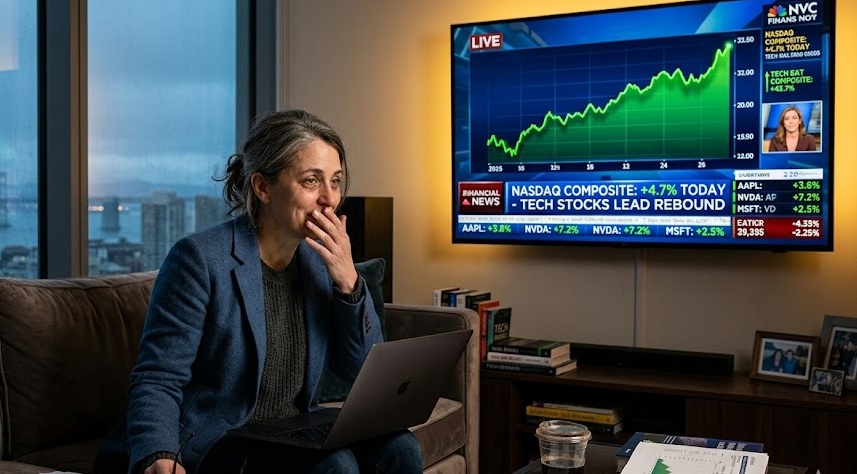
Last week, Dow Jones rose 3.2%, S&P 500 gained 4.5%, and Nasdaq composite was up 6.8%. S&P 500, and Nasdaq hit record highs. The Nasdaq’s 13 day advance was its longest win streak since 1992. TSMC raised its full-year revenue growth forecast to over 30%, reporting US$18 billion in quarterly net income. That said, the semiconductor sector remains sensitive to regulatory friction. ASML shares fell 6% despite raised 2026 guidance, as investors weighed the impact of tightening DUV export restrictions to China. In private markets, demand for AI assets has pushed Anthropic’s speculated valuation toward US$800 billion, as revenue run-rate tripled to US$30 billion since late last year. Cerebras is reportedly entering the public arena with a US$35 billion IPO valuation. The company also signed a US$20 billion compute deal with OpenAI. Amazon is making a strategic US$11 billion move to acquire Globalstar, which could position its LEO satellite network to challenge Starlink’s direct-to-cell dominance by 2027. Meta is projected to surpass Alphabet as the world’s largest ad player this year, reaching US$243 billion in net revenue. This shift is being fueled by AI-driven recommendation improvements in Reels. Allbirds announced plans to abandon footwear for AI chip services, rebranding as NewBird AI. In news pertaining to Sophic clients, Kraken Robotics delivered record 2025 results with $102.2 million in revenue. 01 Quantum is set to demonstrate its IronCAP-based “Quantum AI Wrapper” on April 22, targeting the intersection of FHE and post-quantum cryptography. Replenish Nutrients secured $250,000 in non-dilutive Sustainable CAP funding to accelerate the commercial scale-up of its Beiseker facility.
Canadian Technology Capital Markets & Company News
Sophic Client Kraken Robotics (PNG-TSXV, KRKNF-OTC) announces $28 million in SeaPower Battery and Kraken SAS orders.
Kraken announces approximately $28 million in new orders to five client including two new customers for its SeaPower™ batteries and Synthetic Aperture Sonar (SAS). “These orders include battery contracts from three large international defence companies and a SAS order from a new commercial uncrewed underwater vehicle (UUV) manufacturer,” said Greg Reid, President and CEO of Kraken Robotics. “Our products are now integrated or being integrated into more than 30 different UUV platform types worldwide.” https://tinyurl.com/ycyj9s4c
Sophic Client Kraken Robotics (PNG-TSXV, KRKNF-OTC) reports 2025 financial results.
Kraken Robotics Inc. (“Kraken” or the “Company”) (TSX-V: PNG, OTCQB: KRKNF), announced it has filed its financial results for the fourth quarter and year ended December 31, 2025 (“Q4 2025”). Certain preliminary 2025 year-end results and 2026 guidance were already announced in the news release of the Company dated March 3, 2026 (the “March 3 News Release”), together with the Company’s execution of a definitive agreement to acquire Covelya Group Limited (“Covelya Group”), a leading international provider of mission-critical underwater technology solutions, for total consideration of $615 million, subject to adjustment (the “Covelya Acquisition”). The Covelya Acquisition is expected to close during the second quarter of 2026, subject to the satisfaction of customary closing conditions and receipt of required regulatory approvals. KEY HIGHLIGHTS: Record annual results with 2025 revenue of $102.2 million and Adjusted EBITDA1 of $25.0 million. Stronger 2025 demand for battery and Synthetic Aperture Sonar (“SAS”) products, with new customers. Expanded into LiDAR services via the tuck-in acquisition of 3D at Depth, Inc. (“3D at Depth”) in 2025. Product innovations include a higher energy density battery, LARS for smaller USVs and circular SAS. Increased battery manufacturing capacity with recent completion of new Nova Scotia facility. Strengthened leadership team and Board with several new executives and independent directors. Expect 2026 revenue of $165 million to $175 million and Adjusted EBITDA of $40 million to $50 million. Announced $87 million of product orders to date in 2026, with demand across all product lines. In March 2026, announced the transformational acquisition of UK-headquartered Covelya Group. Updated 2026 guidance for the combined company will be issued at closing of the Covelya Acquisition. https://tinyurl.com/3mv3mya5
Sophic Client 01 Quantum Inc (ONE-TSXV, OONEF-OTCQB) to host Annual Shareholders Meeting followed by a live product demo on Wednesday April 22, 2026.
01 Quantum Inc., one of the first-to-market, enterprise level cybersecurity providers for the quantum computing era, is hosting its annual and special meeting of shareholders on Wednesday April 22, 2026 commencing at 4:00 PM at the offices of its lawyers, Fogler Rubinoff LLP, located at 40 King St. West, Suite 2400, Scotia Plaza Toronto ON M5H 3Y2. Commencing at 4:30 PM following the conclusion of the formal portion of the meeting, Andrew Cheung the Company’s CEO will host a live demonstration of two of its core IronCAP™-based technologies: its Quantum AI Wrapper (“QAW”) and its quantum-resistant digital asset infrastructure, including $qONE and the Layer 1 Migration Toolkit. The live demonstration will showcase how 01 Quantum’s technologies are being applied to two large and rapidly evolving markets: secure artificial intelligence and quantum-safe digital assets infrastructure. Registration for the event can be found below. Andrew Cheung, CEO of 01 Quantum commented, “As we prepare to demonstrate our quantum cybersecurity technologies, we believe investors, partners, and customers will gain a clearer understanding of how 01 Quantum’s platform can be applied to real-world enterprise and digital asset use cases. Our Quantum AI Wrapper (QAW) combines full homomorphic encryption (FHE) with the Company’s IronCAP™ post-quantum cryptography to help protect both user data and AI vendor intellectual property, while our Quantum Crypto Wrapper (QCW) and Quantum DeFi Wrapper (QDW) technologies are designed to help digital assets ecosystems such as Ethereum, Solana, Hyperliquid, and major stablecoins to prepare for Q-Day, when quantum computers are predicted to become powerful enough to break current encryption standards, with potentially wide ranging impacts on all prevalent online privacy and security standards. These demonstrations will highlight the practical applications of our technology platform and the long-term market opportunities we are pursuing in advance of this next evolution in online security standards.” The live demonstration is expected to include: QAW demonstration: showcasing how QAW is designed to enable AI systems to process encrypted data without exposing sensitive prompts, user data, model parameters, or outputs. Encrypted AI inference use case: illustrating how QAW can support special-purpose AI models in high-security sectors such as financial services, healthcare, diagnostics, image recognition, and network traffic analysis. QCW / QDW digital asset protection demonstration: highlighting 01 Quantum’s quantum-resistant digital asset infrastructure, including the $qONE ecosystem token and a preview of qVAULT, the forthcoming quantum-safe vault developed for the qLABS foundation. Layer 1 Migration Toolkit overview: demonstrating how the toolkit is designed to help smart-contract-based blockchains transition toward post-quantum security without disrupting existing infrastructure. IronCAP™ integration: showing how 01 Quantum’s post-quantum cryptography is being applied across both AI and blockchain environments. Commercialization roadmap: providing an update on how the Company intends to advance these technologies through partner-driven deployment models and market-facing opportunities. For those who cannot attend in person we invite you to join us online or dial in to listen. Browser (please cut-and-paste the following link into your browser): https://us02web.zoom.us/j/89726877389?pwd=HftuuixEHTR5JL5e0Iz5MqqpYNbUpt.1 Passcode: 01Quantum. https://tinyurl.com/b3fx2pnz
Sophic Client Replenish Nutrients Holding Corp. (ERTH-CSE, VVIVF-OTC) secures $250,000 in Sustainable CAP funding to support Beiseker facility scale-up.
Replenish Nutrients Holding Corp., a leader in regenerative agriculture solutions, has been approved for a grant of up to $250,000 funded by the governments of Canada and Alberta under the Sustainable Canadian Agricultural Partnership (Sustainable CAP) Value-Added Program. The funding is designated for the Beiseker Granulation project, supporting the Company’s previous 2025 capital investments in fertilizer processing equipment at its Beiseker, Alberta facility. This facility recently achieved significant operational milestones, reaching sustained production rates of 4–5 metric tonnes per hour as it transitions toward full-scale commercial operations. The facility’s targeted output is approximately 2,000 metric tonnes per month once final conveyance, load-out systems, and 24-hour operations are fully implemented. Supporting Diversification, Innovation and Growth. The Sustainable CAP Value-Added Program supports the continued diversification, innovation, growth and prosperity of Alberta’s value-added food and bio-industrial sectors. For Replenish, the grant provides funding for the expansion of the Company’s proprietary zero-waste fertilizer manufacturing facility. Replenish’s technology enables the production of nutrient-dense fertilizers while diverting waste streams from traditional disposal, supporting both environmental sustainability and improved soil health outcomes for farmers. As demand for sustainable agricultural inputs continues to increase, the Company believes its proprietary process positions Replenish to become an important supplier of regenerative fertilizer solution across North America. “We are grateful for the continued support of the Government of Alberta and the Government of Canada through the Sustainable CAP program,” said Neil Wiens, CEO of Replenish Nutrients. “This non-dilutive funding helps accelerate the continued scale-up of our Beiseker production facility. As demand for sustainable soil-health solutions grows, these investments position Replenish to expand production capacity to meet those market opportunities.” About the Sustainable Canadian Agricultural Partnership. The Sustainable Canadian Agricultural Partnership (Sustainable CAP) is a 5-year (2023-2028), $3.5-billion investment by the federal, provincial and territorial governments to strengthen the competitiveness, innovation and resiliency of Canada’s agriculture, agri-food and agri-based products sector. This includes $1 billion in federal programs and activities, and $2.5-billion commitment that is cost-shared 60% federally and 40% provincially/territorially for programs that are designed and delivered by provinces and territories. Strategic Use of Funds. The grant offsets eligible capital investments incurred in 2025 related to the procurement and installation of specialized processing equipment, including advanced granulation components, dryers, and automated controls at the Company’s Beiseker facility. These upgrades support Replenish’s 2026 growth strategy, which focuses on increasing production throughput, improving operational efficiency, and enhancing cash flow visibility as the Beiseker facility transitions toward steady-state commercial production. https://tinyurl.com/6m6y9tyn
SBQuantum nabs US$4 million, new CEO as it preps for US expansion.
Sherbrooke, Québec’s SBQuantum has closed US$4 million ($5.5 million) in seed funding, installed a new leader, and established an American sister entity as the deep technology startup prepares to expand to the United States (US). https://tinyurl.com/s3bf78yf
Global Markets: IPOs, Venture Capital, M&A
Cerebras prepares public listing, eyes US$35 billion-plus valuation.
Chip startup Cerebras is planning to make its IPO paperwork public as soon as Friday. It aims to raise more than US$3 billion and seeks a valuation of at least US$35 billion, which represents a 60% premium to its last private valuation of US$22 billion in February. Cerebras also struck an unusual arrangement with OpenAI. The AI lab agreed to pay Cerebras more than US$20 billion to use servers powered by the firm’s chips over the next three years, double the figure that was previously associated with the deal. As part of the agreement, OpenAI will receive warrants for a minority portion of Cerebras’ shares, and that ownership could increase as it spends more. OpenAI’s spending over the next three years could reach US$30 billion, which could give OpenAI warrants for 10% of the firm. OpenAI also agreed to pay Cerebras US$1 billion to fund the development of data centers that would run its AI products. https://tinyurl.com/vjr3dbmk
VCs are flooding Anthropic with offers to invest at up to an US$800 billion valuation.
Anthropic has fielded multiple offers from VCs valuing the startup behind Claude at as much as US$800 billion in recent weeks, more than double its current valuation, according to multiple people familiar with the matter. Buzzy startups frequently field preemptive offers from investors only to rebuff them. Still, the valuations VCs are floating indicate the feverish demand that has overtaken Silicon Valley for a stake in Anthropic as the company prepares for a possible IPO later this year. A spokesperson for Anthropic declined to comment. Anthropic closed a funding round in February led by GIC and Coatue that valued the company at US$380 billion. That is less than half the US$852 billion valuation OpenAI achieved in the funding round it closed last month. Anthropic is valued at US$688 billion on Caplight, a secondary exchange where investors can trade shares of privately held companies. That is up 75% in three months. Investors and founders have been wowed by Anthropic’s torrid growth and momentum around AI-powered coding assistant Claude code. “They’re crushing it,” Jared Quincy Davis, founder and CEO of Mithril, an AI cloud platform, said about Anthropic last week at HumanX, an AI conference. Anthropic’s run-rate revenue, the revenue a company expects to collect over a year, has soared to $30 billion, up from $9 billion at the end of last year, the company announced last week. It also added that over 1,000 business customers are spending more than US$1 million a year, a figure that has doubled in less than two months. Last week, Anthropic announced its latest model, Mythos, which it said is so powerful it cannot yet be unleashed upon the general public because of the risk of cyber attacks. “The Mythos model is a huge deal, Tomasz Tunguz, founder and general partner of Theory Ventures, said last week at HumanX. “There’s a tremendous amount of excitement.” https://tinyurl.com/y4j94xrj
Amazon to pay around US$11 billion for Globalstar, signs Apple iPhone deal.
Amazon will buy satellite firm Globalstar for around US$11 billion and power satellite features on Apple iPhones, the company said Tuesday, in an effort to challenge SpaceX’s Starlink by adding a direct-to-cell service for its upcoming Leo satellite offering. Globalstar owns wireless spectrum and operates satellites that power backup features on iPhones, allowing users to send text messages and use other limited services from devices in isolated areas away from cell towers. Apple currently owns a roughly 20% equity stake in Globalstar. In the future, Amazon plans to launch more advanced Leo satellites that can power additional direct-to-device services and will “collaborate with Apple on future satellite services using Amazon Leo’s expanded satellite network,” Amazon said. The transaction is expected to close in 2027. Shares of the company were up 9% at US$79.50 before the market opened on Tuesday. Amazon is buying Globalstar for a combination of stock and cash, and the exact price will depend on how Amazon’s stock performs leading up to the deal closing. Based on Amazon’s closing share price on Monday, Globalstar would be valued at about US$10.8 billion. But if Amazon shares climb in the coming months, the deal could value Globalstar at up to US$11.5 billion, according to company disclosures. Amazon plans to launch the initial version of its Leo service in mid-2026, which will beam satellite internet to terminals owned by individual consumers and enterprise customers. Launching a future direct-to-device service will put the company in competition with SpaceX’s Starlink Mobile, which the company started offering last year in the U.S. through a deal with T-Mobile and through otther partners globally. SpaceX has agreed to buy mobile spectrum from Echostar for US$19.6 billion in cash and stock in a deal set to close next year, which will let the company build a new generation of satellites that don’t rely on spectrum from mobile providers. https://tinyurl.com/27emww2u
Deutsche Börse acquires US$200 million stake in Kraken.
Deutsche Börse, the Frankfurt Stock Exchange operator, said it has made a strategic investment of US$200 million in Kraken, representing a 1.5% stake in the crypto exchange. The deal, made through acquiring existing shares, values Kraken at US$13.3 billion. That’s lower than Kraken’s valuation of US$20 billion last November, when it raised US$200 million from Citadel Securities. Shares of Coinbase, Kraken’s biggest competitor in the U.S., have fallen 30% during the same period amid a crypto downturn. Last November, Kraken announced it has filed confidentially for an IPO. https://tinyurl.com/muz5dc7x
Allbirds to pivot to AI chips.
Shoe maker Allbirds is pivoting—into AI chips. Weeks after announcing plans to sell its shoemaking assets to a fashion brand firm American Exchange Group for US$39 million, Allbirds said it wants to turn itself into an AI chip-service firm—leasing and then renting out the valuable AI hardware. To fund the shift, Allbirds plans to raise US$50 million in convertible notes and to change its name to NewBird AI Inc. (the brand name Allbirds will be acquired by American Exchange Group). News of the plans sent Allbirds stock soaring nearly 200% in pre-market trading. Allbirds filed paperwork with the Securities and Exchange Commission, seeking shareholder approval for the asset sale. In the paperwork, Allbirds revealed that its advisors had conducted a liquidity analysis showing that a winding down of the company would have yielded shareholders as little as two cents a share. https://tinyurl.com/mr6kfh7z
TSMC raises revenue forecast as AI chip demand surges.
Taiwan Semiconductor Manufacturing Company on Thursday expects revenue to grow by more than 30% this year, raising its outlook from the forecast it gave in January, as demand for AI chips continues to surge and outruns supply. TSMC, which manufactures the majority of the world’s most advanced chips, reported March-quarter revenue up 35% to US$35.6 billion from a year earlier. Net income grew 58% to US$18 billion. The growth was driven by strong demand for advanced chips used in AI applications as major tech companies race to expand data-center capacity. Still, executives warned that ongoing conflicts in the Middle East could weigh on profitability. CFO Wendell Huang said prices for certain chemicals and gases needed in chipmaking are likely to rise, impacting the company’s future profit margins. Asked about Elon Musk’s Terafab project with Intel, CEO C.C. Wei said TSMC does not underestimate competitors, but that “there are no shortcuts.” Wei said it takes two to three years to build a fab and another one to two years to ramp production, underscoring how difficult it is to replicate TSMC’s manufacturing scale in the short term. https://tinyurl.com/569x5vn7
ASML stock sinks amid tightening China restrictions despite strong earnings, guidance.
ASML stock fell 6% on Wednesday despite raising its sales forecast for 2026 and beating first-quarter revenue and profit expectations. The sell-off comes as the Dutch firm faces tightening restrictions on export controls, which caused a drop in the percentage of net sales to China. ASML said it now sees 2026 net sales to be between 36 billion euros and 40 billion euros, compared to a previous forecast of 34 billion euros to 39 billion euros. The company makes high-end equipment necessary for manufacturing microchips, with its most advanced extreme ultraviolet lithography, or EUV, machines costing upwards of US$400 million. While ASML has never been allowed to sell EUV machines to China, it has long sold its lower-end deep ultraviolet, or DUV, chipmaking machines there. Now that’s poised to change. Last week, a bipartisan group of U.S. lawmakers proposed a bill that would cut off ASML’s sale of DUV machines to Chinese chip companies and impact its already shrinking sales there. That law still needs to work its way through the U.S. legislative process. Still, guidance remains high as ASML sees continued demand for its highest-end EUV machines, which are the only tools in the world capable of the lithography needed to make the most advanced chips used for AI. “The semiconductor industry’s growth outlook continues to solidify, driven by ongoing AI-related infrastructure investments,” ASML CEO Christophe Fouquet said in a press release. “Demand for chips is outpacing supply. In response, our customers are accelerating their capacity expansion plans for 2026 and beyond, supported by long-term agreements with their customers.” This is the first quarter where ASML has not disclosed order numbers, which are a typically closely-watched metric by investors. Fouquet said Wednesday that ASML’s order intake “continues to be very strong.” https://tinyurl.com/hvdx63k4
xAI to rent computing power to Cursor.
SpaceX subsidiary xAI will rent computing power from its data centers to the coding startup Cursor, Business Insider reported. Cursor plans to use tens of thousands of xAI’s chips to train its latest AI coding model, according to the report. The arrangement could help SpaceX, which acquired xAI in February, offset some of the artificial intelligence’s cash burn from building data centers. SpaceX as a whole lost just under US$5 billion in 2025 once its recent merger with xAI is taken into account. xAI’s capital expenditures were close to US$13 billion last year, while revenue from xAI was US$3.2 billion. That figure includes revenue from X, formerly known as Twitter, as well as from sales of xAI’s Grok AI models. https://tinyurl.com/4f55dxuj
Quantum stocks are surging on a fresh AI update from Nvidia.
Quantum computing stocks were among the market’s top gainers in Tuesday’s trading session after Nvidia announced a quantum-focused AI advancement. Nvidia unveiled Ising, an open-source family of AI models that leverages quantum computing technology to address processor calibration and error-correction issues. “AI is essential to making quantum computing practical,” Nvidia CEO Jensen Huang said, adding “With Ising, AI becomes the control plane — the operating system of quantum machines — transforming fragile qubits to scalable and reliable quantum-GPU systems.” Here were the big movers in Tuesday’s session: Xanadu Quantum Technologies: +28%. IonQ: +13%. D-Wave Quantum: +13%. Rigetti Computing: +9%. “Quantum Processor Units (QPUs) are likely to become the next important co-processor in data centers, sitting alongside CPUs and GPUs,” Berstein analysts told clients. “CPUs will remain the workhorse for general-purpose computing, while GPUs dominate highly parallel workloads such as AI. QPUs, in turn, could become essential for a set of problems that are too complex or too costly for classical processors to solve efficiently,” the analysts said. They used an analogy to explain: QPUs can search a 100-million-page phone book all at once while CPUs go page by page. The technology is in its early innings but is expected to revolutionize areas like medical research and energy efficiency, prompting interest from tech giants and governments. The space is a largely speculative trade for investors, given that real-world applications are still some time away. Ramsey Theory Group CEO Dan Herbatschek told Business Insider why Nvidia’s Ising is important for the quantum space. “This is significant because NVIDIA is taking what is a principle from quantum physics and making it actually usable … NVIDIA just brought quantum-like computing to hardware already in existence that organizations have — allowing them to benefit with real business value now.” Quantum Art CEO Dr. Tal David noted that Nvidia Ising “shows the power of hybrid quantum-classical computing, which is at the forefront of the industry.” https://tinyurl.com/4krz4bk5
Dell, HP shares drop after Nvidia denies takeover report.
Dell and HP shares fell about 3% after hours Monday after Nvidia denied a report from website SemiAccurate that claimed the chip giant had been negotiating a deal for more than a year to acquire a large company that makes personal computers. The report didn’t identify the company but Dell and HP, two of the largest PC manufacturers, rallied by about 5% on the news Monday. https://tinyurl.com/4wnh4k63
Netflix reports 16% first quarter growth, as Hastings leaves Board.
Netflix reported 16% higher revenue of US$12.25 billion in the first quarter, slightly above its projections, and revealed that cofounder and former CEO Reed Hastings would leave the board this spring. Hastings had stepped down as CEO three years ago, becoming executive chairman, although about a year ago he stepped back further to become simply chairman and a non-executive director. On Thursday, Netflix said Hastings would exit the board so he could “focus on his philanthropy and other pursuits.” He is leaving as Netflix enters a more challenging era, as its growth slows. The company is increasingly reliant on advertising and price increases to lift revenue. While first quarter revenue was strong, Netflix has forecast a slightly slower full year growth rate of between 12% and 14%. The company projected second quarter growth of 13.5%. Netflix shares fell 8.7% in after-hours trading. https://tinyurl.com/3vyxkev8
Snap lays off 16% of workforce.
Snap said it was laying off about 16% of its workforce, or about 1,000 people, in an effort to reduce its cost base by US$500 million and “establish a clearer path to net income profitability,” CEO Evan Spiegel said in a blog post. He added that advances in AI “enable our teams to reduce repetitive work, increase velocity” and better deal with business partners and advertisers. Spiegel’s announcement comes two weeks after an activist investor and shareholder in Snap called on the company to make “meaningful changes” in how Snap is run, including cutting employee numbers, to lift Snap’s faltering stock price. Snap’s revenue growth has been weak for several years, reflecting limited interest from advertisers in its audience. Snap stock fell to historically low levels last month, below US$4, although it rose 8.7% on Tuesday and was trading up 6% on Wednesday at nearly US$6. https://tinyurl.com/yuz9rj2r
Meta eyes layoffs of 10% of company starting in May.
Meta Platforms plans to lay off of around 8,000 employees next month, with further job cuts expected to occur in the second half of the year, Reuters reported. The initial wave of 8,000 layoffs is scheduled to begin May 20 and will account for about 10% of Meta’s worldwide headcount, Reuters reported. A spokesperson for Meta declined to comment on the report. The company is making the job cuts at a moment when it is pouring vast sums of money into its efforts to catch up in AI. It has previously forecast a 60% to 88% jump in its capital expenditures to between US$115 billion and US$135 billion, in large part due to its build out of AI computing capacity. Other companies have begun to announce substantial reductions in the size of their workforces due to the productivity benefits they expect to see from AI—for example, Block, which said in February that it would cut 4,000 employees or about 40% of the company. Reuters had previously reported that Meta was planning to layoff 20% or more of its workforce. https://tinyurl.com/5n8n4hry
Meta paid Broadcom US$2.3 billion in 2025.
Meta Platforms paid Broadcom US$2.3 billion in 2025, Meta disclosed in a securities filing, a rare disclosure of how much tech firms pay Broadcom for help designing their AI chips.Meta, like Google, uses Broadcom to help design special AI chips. Earlier this week, Meta and Broadcom announced an expansion of their relationship, under which Broadcom will co-develop Meta’s next generations of AI chips. As a result of that announcement, Broadcom CEO Hock Tan is leaving Meta’s board. His presence on the board is why Meta disclosed its payments to Broadcom last year. Broadcom generated US$63.9 billion in the year to November, of which about 58% came from chips. https://tinyurl.com/yau7us3e
Emerging Technologies
Anthropic preps Opus 4.7 model, AI design tool.
Anthropic is preparing its next flagship model, Claude Opus 4.7, along with a new AI-powered tool for designing websites and presentations, according to a person with knowledge of the products. Those new products could be released as soon as this week, the person said. News of the upcoming AI design tool sent the share prices of Adobe, Wix and Figma down more than 2% in the hours following this report. That tool would also pose a threat to startups like presentation-maker Gamma and AI design tool Google Stitch. It aims to help both technical and non-technical users create presentations, websites, landing pages and products using prompts in natural language, the person said. Opus 4.7 isn’t Anthropic’s most advanced model. That model is Claude Mythos, which is currently being tested by a number of early partners which are using it to find security vulnerabilities in their software, due to the model’s advanced cybersecurity capabilities. https://tinyurl.com/2hcw6t57
OpenAI unveils GPT 5.4 Cyber, an AI model for defensive cybersecurity.
OpenAI has announced a new AI model called GPT-5.4-Cyber. Similar to Anthropic’s Claude Mythos, this new “cyber-permissive” variant of its GPT-5.4 is built for defensive cybersecurity and not public use. OpenAI’s newest variant is meant to prepare the way for more capable models to come. OpenAI says that its new GPT-5.4-Cyber variant of GPT-5.4 is specifically meant to prepare the way for more capable models coming this year. https://tinyurl.com/yc8cku57
ByteDance launches Seedance 2.0 globally, excluding the U.S.
ByteDance’s cloud computing unit has made the company’s Seedance 2.0 AI video generation model available globally to enterprise customers in more than 100 countries and regions around the world—but the U.S. is not among them. It is unclear whether the cloud unit, BytePlus, has any plans to offer the model in the U.S. later. The U.S. is not included in BytePlus’s list of countries and regions for its AI model service. Seedance 2.0, released in China in February, faced legal disputes with major U.S. entertainment companies including Disney, Warner Bros. Discovery, Paramount Skydance and Netflix, after videos generated by the model featuring Hollywood celebrities and other copyrighted content went viral on social media. BytePlus’s global launch of Seedance 2.0 comes with major limitations that could be part of the company’s effort to avoid legal issues. Customers are blocked from using realistic images of human faces in their prompts to generate videos. The Information reported last month that ByteDance had put on hold the global launch of Seedance 2.0 due to the copyright challenges in the U.S. ByteDance’s legal team have been working to identify and resolve any potential legal problems, while its engineers are trying to build a better content review system for preventing intellectual property breaches. https://tinyurl.com/mptthecw
Meta raises VR headset prices by as much as US$100.
Meta Platforms is raising prices for its virtual reality headsets by US$50 to US$100 each, citing rising global memory chip costs. The company said Thursday in a blog post that its Meta Quest 3S, first released in 2024, will now cost US$349.99 for the 128GB model and US$449.99 for the 256GB model—both US$50 higher than before—and US$599.99 for the Quest 3 512GB model, which is US$100 higher than before. Memory chips, a key component of GPUs used in both AI servers and gaming computers, have seen surging demand due to the AI boom as they are required in large quantities to train and run machine-learning models. “We’re making this change because the cost of building high-performance VR hardware has risen significantly,” the company wrote. “The global surge in the price of critical components —specifically memory chips—is impacting almost every category of consumer electronics, including VR.” In December, two Meta vice presidents in its hardware division, Gabriel Aul and Ryan Cairns, told employees in a memo that the company would raise prices for its virtual reality devices and factor in new costs, such as tariffs, to ensure long-term sustainability. https://tinyurl.com/52yfjps2
Adtech, Privacy & Regulatory
Meta expected to unseat Google as world’s largest digital-ad player.
Meta Platforms is expected to surpass Alphabet’s Google to become the world’s leading digital-advertising business, a first for the social-media company. Advertising research firm Emarketer projects that Meta will surpass Google in net ad revenue this year, reaching over US$243.46 billion, edging past Google’s US$239.54 billion. The research firm’s estimates account for revenue after deducting traffic and other content acquisition costs, such as the money Google shares with its creators. Meta’s ad business is seeing a lift, thanks to the success of new ad offerings, including the short-form video format Reels, and the broader boost that artificial intelligence has provided. Meta’s AI recommendation system boosted Reels watch time in the U.S. by more than 30% during the most recent quarter, compared with a year earlier, the company said, enabling the platform to serve up more ads. Meta said that Reels is on track to make US$50 billion over the next 12 months, The Wall Street Journal reported. AI is also fundamentally changing how some advertisers create the ads that run across Meta-owned sites. Meta recently said the revenue run rate of video-generation tools hit US$10 billion in the fourth quarter. To be sure, this surging AI-enhanced performance comes with a steep price tag; Meta’s capital spending is expected to reach US$135 billion this year. https://tinyurl.com/5d3raxr3
OpenAI prepares to launch cost-per-click ads in coming days.
OpenAI has told some advertisers that it will allow them to run ChatGPT ad campaigns that charge advertisers based on the number of clicks their ads get within the coming days. The company would offer that new pricing model alongside its existing ads that charge advertisers based on how often their ads are shown. OpenAI has also shared plans to set up ways for advertisers to run ad campaigns aimed at getting ChatGPT users to take a specific action, like making a purchase, though how quickly it could roll out those capabilities is less clear. OpenAI has set ambitious targets for its new ad business, which it launched in February, telling investors it expects around US$2.4 billion in ad revenue this year and US$11 billion in 2027. Hitting next year’s target would make it far bigger than long-established ad sellers like Snap and Pinterest. The planned changes could help OpenAI better compete with ad giants like Meta and Google, which offer advertisers more far more details on how their ads are performing. https://tinyurl.com/mv2csrmb
China’s regulator slaps US$515 million fines on PDD, other food delivery platforms.
China’s regulator said Friday that it had imposed fines totaling 3.52 billion yuan (US$515 million) on seven e-commerce businesses including those operated by PDD Holdings, Meituan, JD.com, Alibaba Group and ByteDance, citing their lack of oversight of problematic food delivery merchants. The State Administration for Market Regulation said in a statement that the seven platforms failed to fulfill their legal obligations to strictly review the licenses and qualifications of food merchants known as “ghost takeout” shops that operate without dine-in premises. The crackdown comes after a battle among e-commerce platforms offering instant deliveries of food and other items escalated into an unhinged price war. PDD got the biggest fine, amounting to 1.525 billion yuan, followed by Meituan’s 698 million yuan. In December, Bloomberg reported that PDD employees got into fist fights with Chinese regulators who were conducting investigations at the company’s Shanghai headquarters. PDD fired dozens of employees on its government relations team after the incident, according to Bloomberg. The fines for JD.com and Alibaba were 629 million yuan and 614 million yuan, respectively. ByteDance’s fine was much smaller, at 48 million yuan. In addition to the fines, the regulator also confiscated the companies’ illegal gains, worth 101 million yuan in total. Fifteen executives at the seven companies were also slapped fines totalling 19.7 million yuan. In China, ghost takeout merchants with no physical storefronts became problematic on food delivery platforms, as some operated under highly unhygienic conditions and others evaded inspection and other regulations. https://tinyurl.com/5cxebver
Disclaimer
The information and recommendations made available through our emails, newsletters, website and press releases (collectively referred to as the “Material”) by Sophic Capital Inc. (“Sophic” or “Company”) is for informational purposes only and shall not be used or construed as an offer to sell or be used as a solicitation of an offer to buy any services or securities. In accessing or consuming the Materials, you hereby acknowledge that any reliance upon any Materials shall be at your sole risk. In particular, none of the information provided in our monthly newsletter and emails or any other Material should be viewed as an invite, and/or induce or encourage any person to make any kind of investment decision. The recommendations and information provided in our Material are not tailored to the needs of particular persons and may not be appropriate for you depending on your financial position or investment goals or needs. You should apply your own judgment in making any use of the information provided in the Company’s Material, especially as the basis for any investment decisions. Securities or other investments referred to in the Materials may not be suitable for you and you should not make any kind of investment decision in relation to them without first obtaining independent investment advice from a qualified and registered investment advisor. You further agree that neither Sophic, its, directors, officers, shareholders, employees, affiliates consultants, and/or clients will be liable for any losses or liabilities that may be occasioned as a result of the information provided in any of the Material. By accessing Sophic’s website and signing up to receive the Company’s monthly newsletter or any other Material, you accept and agree to be bound by and comply with the terms and conditions set out herein. If you do not accept and agree to the terms, you should not use the Company’s website or accept the terms and conditions associated to the newsletter signup. Sophic is not registered as an adviser or dealer under the securities legislation of any jurisdiction of Canada or elsewhere and provides Material on behalf of its clients pursuant to an exemption from the registration requirements that is available in respect of generic advice. In no event will Sophic be responsible or liable to you or any other party for any damages of any kind arising out of or relating to the use of, misuse of and/or inability to use the Company’s website or Material. The information is directed only at persons resident in Canada. The Company’s Material or the information provided in the Material shall not in any form constitute as an offer or solicitation to anyone in the United States of America or any jurisdiction where such offer or solicitation is not authorized or to any person to whom it is unlawful to make such a solicitation. If you choose to access Sophic’s website and/or have signed up to receive the Company’s monthly newsletter or any other Material, you acknowledge that the information in the Material is intended for use by persons resident in Canada only. Sophic is not an investment advisor nor does it maintain any registrations as such, and Material provided by Sophic shall not be used to make investment decisions. Information provided in the Company’s Material is often opinionated and should be considered for information purposes only. No stock exchange or securities regulatory authority anywhere has approved or disapproved of the information contained herein. There is no express or implied solicitation to buy or sell securities. Sophic and/or its principals and employees may have positions in the stocks mentioned in the Company’s Material and may trade in the stocks mentioned in the Material. Do not consider buying or selling any stock without conducting your own due diligence and/or without obtaining independent investment advice from a qualified and registered investment advisor. The Company has not independently verified any of the data from third party sources referred to in the Material, including information provided by Sophic clients that are the subject of the report, or ascertained the underlying assumptions relied upon by such sources. The Company does not assume any responsibility for the accuracy or completeness of this information or for any failure by any such other persons to disclose events which may have occurred or may affect the significance or accuracy of any such information. The Material may contain forward looking information. Forward-looking statements are frequently, but not always, identified by words such as “expects,” “anticipates,” “believes,” “intends,” “estimates,” “potential,” “possible,” “projects,” “plans,” and similar expressions, or statements that events, conditions or results “will,” “may,” “could,” or “should” occur or be achieved or their negatives or other comparable words and include, without limitation, statements regarding, projected revenue, income or earnings or other results of operations, strategy, plans, objectives, goals and targets, plans to increase market share or with respect to anticipated performance compared to competitors, product development and adoption by potential customers. These statements relate to future events and future performance. Forward-looking statements are based on opinions and assumptions as of the date made, and are subject to a variety of risks and other factors that could cause actual events/results to differ materially from these forward looking statements. There can be no assurance that such expectations will prove to be correct; these statements are no guarantee of future performance and involve known and unknown risks, uncertainties and other factors. Sophic provides no assurance as to future results, performance, or achievements and no representations are made that actual results achieved will be as indicated in the forward looking information. Nothing herein can be assumed or predicted, and you are strongly encouraged to learn more and seek independent advice before relying on any information presented.