
April 25, 2026: Fresh Highs, Big Earnings Week Next
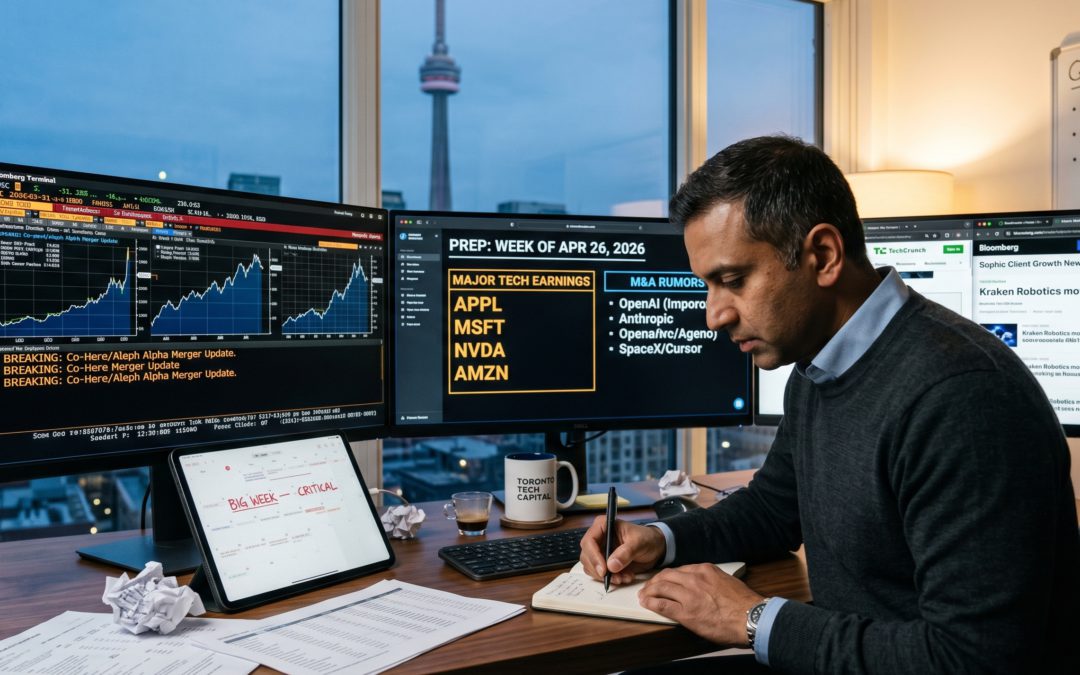
After a geopolitical driven mid-week pause, markets closed decisively higher. Dow Jones lost 0.4% last week, S&P 500 gained 0.55%, Nasdaq composite was up 1.5%. Nasdaq and S&P 500 hit fresh highs Friday, aided by chip stocks. Multiple hyper scalers and AI related companies are expected to report earnings next week, amidst ongoing geopolitical volatility. Google and Amazon committed a combined US$65 billion in new funding and compute capacity to Anthropic, which is now seeing investor interest at a US$800 billion valuation. OpenAI is forming a US$10 billion joint venture, called DeployCo, to drive enterprise adoption. SpaceX is reportedly preparing for its June IPO, and also potentially acquiring AI coding startup Cursor for US$60 billion. Cursor’s annualized revenue recently hit US$2.7 billion. Nuclear startup, X-energy went public, raising US$1 billion in its IPO. Intel shares soared 20% on strong data center growth. Revolut is targeting a US$200 billion valuation for its eventual IPO. Tesla reported a 16% revenue increase to US$22.4 billion, as it pivots to its Robotaxi service. ServiceNow shares fell despite 22% growth due to Armis acquisition “headwinds,”. Adobe announced a US$25 billion buyback. In Canada, Cohere and Germany’s Aleph Alpha agreed to a US$20 billion transatlantic merger. In news pertaining to Sophic clients, Kraken Robotics’ CEO was interviewed by BNN Bloomberg, highlighting the company’s position in the new underwater arms race. Rivemont Portfolio Manager, Mathieu Martin, highlighted his funds’ his 50+ bagger investment journey with Kraken Robotics on the “In the Money” podcast. Replenish Nutrients expanded its credit facilities to $5.45 million to scale its Beiseker facility and tackle global phosphate gaps. 01 Quantum recently demonstrated its quantum-safe solutions at its Toronto AGM and also provided investors a business overview at an investor conference. Hybrid Power Solutions partnered with Movex Innovation to deliver NATO-compliant mobile power units. Renoworks Software reported FY2025 revenue of $7.7 million, with licensing revenue jumping 33% as it transitions to an AI-driven platform.
Canadian Technology Capital Markets & Company News
Cohere and Aleph Alpha agree US$20 billion transatlantic AI tie-up.
Canadian AI start-up Cohere has agreed to take over Germany’s Aleph Alpha in a deal valuing the combined group at about US$20 billion, as western governments and companies seek alternatives to US Big Tech providers. The transaction, supported by the German and Canadian governments, will create a transatlantic company focused on “sovereign” AI systems that allow customers to retain control over their data and infrastructure. The merger reflects growing concern outside the US about reliance on Silicon Valley groups such as OpenAI and Google. Cohere, the larger partner, will retain its name and operate with dual headquarters in Canada and Germany. Aleph Alpha shareholders will receive one Cohere share for every nine shares held, according to two people familiar with the terms. The deal will be accompanied by a fresh funding round led by Schwarz Group — the retail company, which owns supermarket Lidl — which said it has committed US$600 million, including equity and research funding. https://tinyurl.com/yc89yasm
Investment firm 2717 offers $10.50 a share for edtech D2L.
2717 argues that D2L would be more able to boost its revenue as a private company. Investment firm 2717 Partners has made a non-binding offer to acquire D2L Inc. in a deal that would value the Canadian education technology provider at $572 million on an equity basis, according to a letter reviewed by Bloomberg News. The stock rose as much as 15 per cent. The firm proposed to buy D2L for $10.50 a share in cash, pending due diligence, shareholder approval and other closing conditions, according to the letter dated April 13. https://tinyurl.com/2nw44p79
A&K Robotics closes $8 million Series A round to put self-driving pods in airports.
Vancouver-based A&K Robotics, which builds self-driving “mobility pods” for airports, has secured $8 million in Series A financing. A&K’s all-equity, all primary capital Series A round closed in late December. It was co-led by BDC Capital’s Industrial Innovation Venture Fund and New York’s Vantage Futures, the corporate venture capital arm of airport and transportation infrastructure firm Vantage Group. Fellow new investors included Toronto-based RiSC Capital, Silicon Valley’s Grep VC, Vancouver-based Nimbus Synergies. . https://tinyurl.com/29uwjrxw
Sophic Client Kraken Robotics (PNG-TSXV, KRKNF-OTC) CEO BNN Bloomberg Interview, highlighting the Company’s position in the new underwater arms race.
As the war in Iran intensifies the need for underwater security, a Canadian marine technology company says it stands to greatly benefit. Kraken Robotics says it is seeing a rapid increase in global demand for its subsea technology as nations intensify defence and security spending. “Around the world, there’s a number of hotspots, and as it relates to maritime security, our technologies are seeing quite considerable demand on that front,” says Greg Reid, president and CEO of Kraken Robotics. The war in Ukraine and rising tensions have highlighted the vulnerability of undersea oil pipelines and communication cables. Countries beyond the major powers like Russia, China and the U.S. have been ramping up their underwater presence. Reid says his company saw an increase in interest after the Nord Stream explosion in September 2022, where the Russian-German gas link was broken after three of the four natural gas pipelines were bombed. Now the war in Iran brings similar concerns, he says. “The Strait of Hormuz, you know, the real challenge there is underwater mines,” says Reid, adding that his company’s technology was developed when the company first started mine hunting applications. “So we are one of probably three or four companies in the world that have this type of capability,” says Reid. Expanding global maritime capabilities. Kraken Robotics announced a massive deal last month, expected to close this quarter. The company is in the midst of acquiring Covelya Group Limited, a UK-based provider of underwater technology, for a total of $615 million. “It’s really transformative for overall business,” says Reid, adding that the businesses complement each other, “If you think about the underwater drone space, some of the largest customers in the world, we are providing key systems and subsystems into them, and the Covelya Group adds additional content in those underwater drones.” Reid says the company already has some contracts with the Canadian government for the Canadian Navy and expects more business as a result of the increase in defence spending. He says the 14 year old company has operated in all geographies whether it’s in the Mediterranean or the Middle East or the Canadian Arctic. Soon to be on the Toronto Stock Exchange. Reid expects Kraken Robotics to be listed on the Toronto Stock Exchange in the second half of 2026. The company is already listed on the TSX Venture Exchange. “I characterize it as if it wasn’t for this Covelya acquisition, we would already be there,” says Reid. “We believe we pass all the tests in terms of the financial metrics required to be on the TSX. So we’re really focused now on closing this, actually acquisition of Covelya here in Q2.” He says despite a slight miss in the final quarter of last year, the company’s annual performance was strong, jumping from $10 million to over $100 million in revenue in just four years. He said a few orders slipped into the first half of 2026, which affected the first quarter, but the company still expects a 60 per cent revenue growth in the coming year with high profit margins. “The quarters can be lumpy at times, but overall, the business is seeing a lot of good demand, and this acquisition is something that we’re definitely excited about,” says Reid. https://tinyurl.com/yv4s4uj5
Sophic Client Kraken Robotics (PNG-TSXV, KRKNF-OTC): Mathieu Martin, Portfolio Manager at Rivemont MicroCap Fund on the “In the Money” podcast, with Amber Kanwar discussed his investment process in the stock.
Mathieu spoke about his 50+ bagger on Kraken Robotics, highlighting his investment process, and journey since 2018 as a shareholder in the Company. An interesting listen for all micro cap investors. https://tinyurl.com/ytu2hen2
Sophic Client Replenish Nutrients Holding Corp. (ERTH-CSE, VVIVF-OTC) expands revolving credit facilities by $1.95 million to support Beiseker scale-up and licensing growth.
Replenish Nutrients has renewed and expanded its two existing revolving credit facilities increasing total available credit capacity by $1.95 million. Following the amendments, the combined authorized limit across both facilities is $5.45 million, providing additional working capital to support the Company’s 2026 growth initiatives at its Beiseker, Alberta production facility and its expanding licensing programs with Farmers Union Enterprises and MJ Ag Solutions. The two facilities, which were originally entered into in 2025, have been renewed with no change to the terms and conditions previously in place. The renewed facilities continue to be secured by specific assets of the Company and its subsidiaries, bear interest at the same rate, and retain the same one-year renewable term structure. CEO Commentary. “This expansion of our revolving credit facilities is an important step in providing Replenish with the financial flexibility to execute on our 2026 growth plan,” said Neil Wiens, CEO of Replenish Nutrients. “This non-dilutive funding supports our ability to scale production at Beiseker and our licensing partnerships, positioning the Company to capture the growing demand for sustainable, regenerative fertilizer solutions.” https://tinyurl.com/36wtkvzp
Sophic Client Replenish Nutrients Holding Corp. (ERTH-CSE, VVIVF-OTC) targets fertilizer supply gaps with local AG tech model.
Replenish Nutrients CEO Neil Wiens joined Steve Darling from Proactive to outline how the company is tackling global fertilizer supply challenges through localized, biology-based solutions powered by its proprietary ag-tech platform. In the interview, Wiens explained that Replenish Nutrients is focused on producing mineral-based fertilizers using locally sourced inputs, reducing dependence on complex and often fragile global supply chains. This approach comes at a critical time, as geopolitical tensions and trade disruptions continue to strain the availability and pricing of key agricultural inputs. Wiens pointed to phosphate supply as a major concern, noting that global production is heavily concentrated, with Morocco accounting for the majority of supply and very limited sources across North America. This concentration has created vulnerabilities for farmers, particularly as shipping disruptions and logistical bottlenecks impact timely delivery. A cornerstone of the company’s strategy is its “capital light” licensing model, which enables regional partners to deploy Replenish’s technology and establish localized production facilities. https://tinyurl.com/zfy3edpa
Sophic Client 01 Quantum Inc (ONE-TSXV, OONEF-OTCQB)-A Quantum primer.
CEO Andrew Cheun, broke down and simplified quantum safe technologies and the company’s solutions in this key area at an investor presentation. This is a great primer for investors who want to understand how quantum computing’s evolution will impact technology solutions and what measures companies can take to protect themselves and their data. Additionally, at the company’s AGM in Toronto last week, management demonstrated the company’s solutions and platform for investors.
Company and solution overview — https://tinyurl.com/mt89dk7s Solution demonstration — https://tinyurl.com/w23je4x9
Sophic Client Hybrid Power Solutions (HPSS-CSE, HPSIF-OTC) and Movex Innovation to deliver Spark-powered mobile solutions for defence and commercial applications.
Hybrid Power Solutions, announces a collaboration with Movex Innovation to offer a fully mobile power solution that pairs Hybrid’s Spark platform with Movex Innovation’s ultra-compact, remote-controlled electric equipment platform for defence and commercial use. The collaboration is expected to create a transportable and flexible field power solution for mission-critical and industrial environments by integrating Hybrid’s Spark with Movex Innovation’s mobile equipment line. The collaboration will service diverse end-markets with potential use cases including remote job sites, defence logistics, infrastructure maintenance, emergency response, mining support and other field operations requiring both mobility and dependable off-grid or hybridized power. The resulting solution is expected to offer customers a resilient, cleaner and quieter alternative to legacy mobile generator systems while helping improve operational efficiency in numerous field applications. “This collaboration marks a significant advancement in mobile power innovation,” said Francois Byrne, CEO and Founder of Hybrid Power Solutions. “By integrating our Spark platform with Movex Innovation’s advanced mobility systems, we are delivering a highly versatile solution tailored for customers in both the defence and commercial sectors, where access, safety, emissions, noise, and operational flexibility are critical.” Hybrid also plans to build a custom high-capacity battery system tailored for Movex Innovation’s ultra-compact All-Terrain Track Carrier and associated material handling units, incorporating advanced lithium-ion cells, intelligent hybrid power management, and full compliance with key NATO standards including relevant STANAG requirements for defence interoperability, environmental resilience, and power interface compatibility in coalition operations. The Company is actively advancing manufacturing plans to scale production of this NATO-compliant custom battery, delivering extended runtime, rapid charging, silent electric operation, and rugged performance to support Movex’s remote-controlled electric platforms in demanding defence, mining, and industrial field applications while reducing logistical burden and enhancing mission flexibility. Movex Innovation specializes in ultra-compact, remote-controlled electric industrial handling equipment designed for confined spaces, rough terrain and demanding operating conditions. Its equipment platform is used across a range of industries and includes applications for military and defence operations, where quiet electric operation, compact form factor and reduced physical risk can offer meaningful operational advantages. “Movex Innovation is committed to developing compact, safe, and high-performance electric equipment engineered for the most challenging environments,” said William Lavoie, Director of Business Development at Movex Innovation. “Through this partnership with Hybrid Power Solutions, we are enhancing our platform’s capabilities by incorporating reliable mobile power solutions, thereby ensuring superior access, uptime, and safety for demanding applications.” https://tinyurl.com/bdcsamkb
Sophic Client Renoworks Software Inc. (RW-TSXV, ROWKF-OTC) announces annual and fourth quarter 2025 financial results.
Financial highlights for the 2025 fiscal year with comparatives for 2025 are as follows: Revenues of $7,739,358, a 12% increase from the prior period’s $6,942,578. Deferred Revenue of $2,436,650 December 31, 2025 compared to $2,519,797 at December 31, 2024. Recurring revenue of $3,662,811 versus $2,764,398 for the same period in 2024, a 33% increase. Gross margin of 77% versus 74% in 2024. Net profit of $18,519 compared to a net profit of $133,058 for the same period in 2024. Cash at December 31, 2025 was $1,444,728, a decrease of $91,943 from $1,536,671at the end of fiscal 2024. As at December 31, 2025, the Company had 40,867,968 common shares issued and outstanding. Financial highlights for the fourth quarter of fiscal 2025 with comparatives for 2024 are as follows: Quarterly revenue of $1,723,794 for the three months ended December 31, 2025 versus $1,732,703 in 2024. Recurring revenue of $989,813 versus $802,548 for the same period in 2024, a 23% increase. Gross margins continue to be strong at 80% and 74%, respectively for the fourth quarters of 2025 and 2024. Net loss of $94,551 for the quarter ended December 31, 2025 compared to a net income of $135,688 in 2024. Renoworks reported a 12% increase in revenues for the 2025 fiscal year compared to the same period in 2024. This growth was driven by a 33% rise in licensing revenue and a 38% increase in implementation revenue. The Company earned aggregate revenues of $7,739,358, including $3,662,811 from licensing and hosting, $2,527,453 from design services, $851,575 from libraries, and $697,519 from implementation fees. Net profit for the fiscal year ended December 31, 2025, was $18,518, a decrease compared to the net income of $133,058 reported for the same period in 2024. The decrease was primarily driven by increased overall expenditures to support the company’s growth as well as decreased foreign exchange gains. “2025 was a pivotal year for Renoworks as we made meaningful progress in transitioning our business toward scalable, higher-margin recurring revenue,” said Doug Vickerson, Chief Executive Officer of Renoworks. “We saw strong growth in licensing and hosting revenue, up 33% year-over-year, alongside a deliberate reduction in design services as customers increasingly adopt our higher-margin AI-driven platform. This shift is foundational to our long-term strategy–expanding Annual Recurring Revenue, improving gross margins, and increasing revenue predictability. While we continued to invest in AI, data science, and our contractor ecosystem to support future growth, these investments are already translating into stronger enterprise retention, expansion within our existing customer base, and early traction in our AI application suite. As we move into 2026, we expect this transition to accelerate, with continued ARR growth, deeper customer adoption of our platform, and a further strengthening of our position as a leader in digital transformation for the remodeling and new home construction industry. Our focus is on scaling ARR, deepening enterprise adoption, and delivering measurable ROI for our customers as the industry continues its digital transformation.” https://tinyurl.com/4ryk49yv
Global Markets: IPOs, Venture Capital, M&A
Flurry of US IPOs race to tap market ahead of SpaceX debut.
The US IPO market has gone from desolate to bustling in a matter of weeks, with companies looking to raise as much as US$17.3 billion this month alone and capitalize on stocks’ resilience. Debuts in the coming weeks are set to raise billions of dollars as companies look to go public before what’s expected to be the market’s biggest event of the year: SpaceX’s record-breaking initial public offering, which Elon Musk’s firm is planning for June. The pickup in IPOs this month has raised US$5.4 billion, and newly-public companies sparked excitement across Wall Street when they started making people money again. The weighted-average return for the year’s US IPO class, excluding blank-check vehicles and closed-end funds, has jumped to 21% from just 4.6% about a week ago, data compiled by Bloomberg show. That outpaces a 4.2% return for the benchmark S&P 500 Index. Companies have been deploying several strategies to increase the likelihood their IPOs will succeed, including lining up so-called cornerstone investors, offering a smaller pool of shares in the deal and starting with attractive discounts to publicly-listed peers. This week’s expected IPOs are seeking to raise nearly US$2 billion in aggregate. X-Energy Inc., a nuclear energy firm that counts Amazon.com Inc. as a backer, is targeting US$814 million. The deals would build on what’s been the busiest month for bankers since December saw roughly US$8.8 billion raised, primarily driven by Medline Inc.’s blockbuster debut. The success of the coming deals will shape the landscape for more than a dozen other companies waiting in the wings to price IPOs from artificial intelligence chipmaker Cerebras Systems Inc. to Blackstone Inc.’s data-center acquisition vehicle. Both are expected to target at least US$2 billion each, which would deliver consecutive months of notable IPO activity before SpaceX’s likely record-setting debut. https://tinyurl.com/k2u6mczd
Nuclear startup X-energy raises US$1 billion in data center-driven IPO.
Nuclear startup X-energy raised US$1 billion in its initial public offering, selling 44.3 million shares for US$23 each, a hefty premium above the US$16 to US$19 per share it was seeking. Initially, the company had hoped to raise around US$800 million. X-energy is building small modular reactors capable of generating electricity or delivering heat to industrial processes. The company has a deal with Dow to provide heat and power to a chemical plant in Texas and another with Amazon to sell as much as 5 gigawatts of nuclear power by 2039. Amazon’s Climate Pledge Fund led X-energy’s Series C-1 round. Nuclear startups like X-energy have been buoyed by surging demand for electricity from data centers and other parts of the economy that have been electrifying. The company says its reactors will generate 80 megawatts of electricity. https://tinyurl.com/mpaf3pt3
Nvidia supplier Victory Giant surges 60% in Hong Kong stock debut.
Victory Giant Technology, one of Nvidia’s Chinese hardware suppliers, jumped as much as 60% on its debut on the Hong Kong Stock Exchange, as investors sought to capitalize on the global AI infrastructure boom. Shares of Victory Giant, which manufactures printed circuit boards used in AI servers, started trading in Hong Kong Tuesday after the company raised about US$2.6 billion in the city’s largest initial public offering this year so far. The company’s stock is also listed on mainland China’s Shenzhen Stock Exchange. Victory Giant’s strong Hong Kong debut reflects investor confidence in leading hardware component suppliers that are benefitting from massive demand for high-end AI servers and data center infrastructure. In its IPO filing, Victory Giant, which is based in the southern Chinese city of Huizhou, said its revenue rose 80% to 19.29 billion yuan (US$2.83 billion) last year, while its net profit more than tripled to 4.31 billion yuan. https://tinyurl.com/5hexxwzw
Google to invest up to US$40 billion in Anthropic, agrees to five Gigawatt compute deal.
Google has agreed to make an additional investment in Anthropic of up to US$40 billion, deepening a multi-pronged relationship that also includes a major expansion of Anthropic’s access to AI servers. The search engine company, an early backer of Anthropic, will initially invest US$10 billion in at a US$350 billion valuation, according to a source close to Google and another source close to Anthropic. That’s the same valuation at which Anthropic raised money from investors in February. Google will invest the remaining US$30 billion once Anthropic reaches certain unspecified performance targets, the people said. Google will also supply five gigawatts of compute to Anthropic starting next year, adding to a string of recent deals to boost the startup’s access to servers to run and train its models. Such arrangements could counter doubts from some observers, including rival OpenAI, that Anthropic had secured enough servers to keep up with its recent fast growth. Earlier this week, Anthropic said it had secured five gigawatts worth of computing power from Amazon to come online by the end of this year. Amazon also agreed to invest US$25 billion in Anthropic. https://tinyurl.com/mr3527xw
Amazon to invest up to US$25 billion in Anthropic.
Amazon is investing US$5 billion into Anthropic now and will invest up to an additional US$20 billion tied to commercial milestones, the companies said on Monday. The deal is on top of US$8 billion Amazon previously invested in the artificial intelligence company. While the companies did not say what milestones need to be met to unlock the additional investments, Anthropic said it plans to spend more than US$100 billion on Amazon Web Services over the next decade, including on Amazon’s custom Trainium chips. AWS customers will now be able to use the Claude Platform directly in AWS, in addition to accessing Claude through Amazon’s Bedrock service, the companies said. Anthropic will get access to five gigawatts worth of AI compute through the deal and will gain inference capacity in Asia and Europe, the companies said. In addition to Amazon, Anthropic has computing deals with other companies including Google, Microsoft and CoreWeave. https://tinyurl.com/3uvf9tvb
Anthropic has received investor interest at US$800 billion valuation.
Anthropic has received expressions of interest from investors who want to put money into the AI startup at an US$800 billion valuation, but the company has no current plans to raise money. A decision on raising more money likely won’t happen until after Anthropic’s May board meeting, a person with knowledge of the company’s plans told The Information. Some Anthropic investors believe the company could fetch a US$1 trillion valuation, which would represent more than 2.5 times its US$380 billion valuation in January. Rao has guided Anthropic through multiple fundraising rounds since he joined Anthropic in 2024. He has also pushed the company to expand its relationship with multiple cloud computing and chip providers. https://tinyurl.com/4yztp7cn
OpenAI in talks to invest up to US$1.5 billion in Private Equity Joint Venture.
OpenAI is in discussions to invest up to US$1.5 billion in a private equity joint venture called DeployCo, according to a person with knowledge of the effort. The ChatGPT maker is in talks to invest US$500 million initially in DeployCo, which is expected to be valued at US$10 billion. OpenAI has the option to invest an additional US$1 billion at a later date at the same valuation. The joint venture is in partnership with a suite of private equity firms, including TPG, Bain Capital, Advent International, Brookfield and Goanna Capital, which are expected to invest an additional US$4 billion into DeployCo, the person said. OpenAI seeks to accelerate businesses’ adoption of its AI tools by selling to private equity firms’ portfolio companies through DeployCo. Anthropic, too, is in talks to form a joint venture with private equity firms including Blackstone and Hellman & Friedman to sell its AI services to their portfolio companies. The Financial Times was first to report details of OpenAI’s investment into the joint venture. https://tinyurl.com/2uafkb99
Meta signs deal to use Amazon’s CPUs for agentic workloads.
Meta and Amazon announced a deal on Friday for Meta to use Amazon’s Graviton chips. The deal, which a spokesperson said will total several billion dollars over multiple years, comes as Meta has been spending heavily on chips and cloud storage as it tries to turn itself into an AI powerhouse. Amazon’s Graviton chips are a CPU designed for general computing, unlike GPUs which are specific for training AI models. Meta is renting Amazon’s Graviton5 chips, a spokesperson said, which came out late last year. Amazon says Graviton5 is purpose built for AI-related work like reasoning and code generation. Previously Meta rented GPU clusters from AWS, bought core cloud services and ran inference via Amazon Bedrock, a spokesperson said. In 2026 alone, Meta has inked multi-billion dollars to use chips from Nvidia, AMD and Google and to rent cloud space from CoreWeave and Nebius. Meta said its capital expenditures would run between US$115 billion and US$135 billion this year, with much of that going toward chips and servers. Meta is also trying to develop its own chips, though some of those efforts have hit roadblocks. https://tinyurl.com/2nf2x5xs
Revolut eyes valuation of up to US$200 billion in eventual IPO.
British neobank Revolut seems to be eyeing a major valuation bump when it eventually goes public. The company is targeting a market cap between US$150 billion and US$200 billion in an initial public offering, the Financial Times reported on Tuesday, citing anonymous investor sources. The fintech giant, which secured a full banking license in the United Kingdom in March after years of waiting, was most recently valued at US$75 billion, up from US$45 billion in 2024, in a secondary share sale that made it one of Europe’s most valuable private tech companies. Revolut’s co-founder and CEO, Nik Storonsky, last week said that the company’s IPO was at least “two years away,” according to Bloomberg. According to PitchBook and the Financial Times, the company is working on another secondary share sale, scheduled for the second half of 2026, that would value it at more than US$100 billion. As of November 2025, the company had raised a total of US$5.89 billion, according to PitchBook. Revolut reported revenue of $6 billion in the financial year ended December 31, 2025, up from US$4 billion in 2024. The company’s net profit grew to US$1.7 billion, up from US$1 billion in 2024, and counted 68.3 million retail customers at the end of 2025. https://tinyurl.com/mvf8zhvs
Polymarket discusses funding at a roughly US$15 billion valuation.
Predictions site Polymarket is in discussions with investors about US$400 million in funding at around a US$15 billion valuation, which would add to US$600 million that Intercontinental Exchange recently invested in the company. This valuation is substantially lower than rival Kalshi’s US$22 billion round. Kalshi’s higher valuation stems from its existing U.S. customer base and US$1.5 billion in annualized revenue, while Polymarket just recently launched its U.S. platform and began charging fees. https://tinyurl.com/mrys3ysk
SpaceX says it can buy Cursor for US$60 billion later this year.
SpaceX, which owns artificial intelligence lab xAI, said Tuesday it has agreed to a potential acquisition of AI coding startup Cursor for US$60 billion. The Elon Musk-founded rocket company, which is preparing for what could be the world’s biggest IPO in June, said in a post on X that Cursor had agreed to let SpaceX buy it at that price later this year. If SpaceX doesn’t, it would pay Cursor US$10 billion “for our work together,” the post said. A person familiar with the agreement described the US$10 billion as a breakup fee. The two companies are “working closely together to create the world’s best coding and knowledge work AI,” the SpaceX post said, adding that SpaceX aims to use the combination of Cursor’s product and customer base of software engineers with SpaceX’s large computing resources to “build the world’s most useful models.” Cursor most recently raised funds at a valuation of US$27 billion before the investment, meaning the acquisition, if it closes, would more than double that valuation. The startup was recently raising a US$2 billion funding round, led by Thrive Capital and Andreessen Horowitz, that would’ve valued it at US$50 billion. That round is no longer happening, according to a person with direct knowledge of the fundraise. https://tinyurl.com/32b9vb6k
Cursor’s revenue pace recently passed US$2.7 billion, helping margins turn positive.
AI coding startup Cursor, which recently agreed to a potential US$60 billion acquisition by SpaceX, last month hit US$2.7 billion in annualized revenue, 14 times higher than that revenue pace a year ago. Some investors expected annualized revenue to hit more than US$7 billion by year’s end. Cursor’s revenue should deepen the AI revenue at SpaceX. In its last fiscal year, which ended in January, Cursor generated about US$770 million in total revenue, or almost a quarter of the revenue generated last year by SpaceX’s AI division, which now includes xAI, according to the report. Meanwhile, the startup’s gross margin—revenue after accounting for the core cost of its product—was negative 23% as of the quarter ended in January. It has recently turned positive. And Cursor lost nearly US$900 million in its last fiscal year. https://tinyurl.com/5297bba4
Tesla discloses US$2 billion deal for unnamed AI hardware company.
Tesla is acquiring an unnamed AI hardware company for up to US$2 billion, the company disclosed in a securities filing on Thursday. The electric automaker is paying for the company in common stock and equity awards, US$1.8 billion of which is subject to conditions and milestones “dependent on the successful deployment of the company’s technology,” the filing shows. Tesla made no mention of the deal in its first-quarter 2026 results presentation on Wednesday or on an earnings call with CEO Elon Musk and other executives. The identity of the company Tesla acquired could not immediately be learned. https://tinyurl.com/4hhu86um
Tesla revenue grew 16% in first quarter.
Tesla revenue reached US$22.4 billion in the first quarter, a 16% year-over-year increase, showing that the electric vehicle maker has started to dig its way out of a sales slump. The revenue figure is slightly better than the same period in 2024 but well below the US$24.3 billion in revenue Tesla reported during the first quarter of 2023. As the electric vehicle business has stagnated over the past couple of years, CEO Elon Musk has refocused the company on the Optimus humanoid robot and its nascent Robotaxi service, neither of which have significantly contributed to revenue. In Tesla’s presentation for investors, the company said it was making progress on the rollout of Robotaxi, highlighting an extremely limited launch of the service in Houston and Dallas earlier this month. While Tesla’s previous earnings presentation said that five additional cities including Miami and Las Vegas as Robotaxi would come online in the first half of the year, Wednesday’s presentation did not repeat that deadline, instead listing the cities as “preparations underway” with no target date. https://tinyurl.com/yc7hyw3p
Intel’s stock soars 20% as results top estimates, with chipmaker showing signs of growth.
Intel reported first-quarter earnings Thursday that blew past Wall Street’s expectations, as the struggling chipmaker shows signs of a revival. Shares of the U.S. chipmaker jumped 20% in after-hours trading. Intel has been a Wall Street darling of late, with its stock up more than 80% this year as of Thursday’s close, after soaring 84% in 2025. The chipmaker has been hampioned by the Trump administration, which turned the U.S. government into the largest shareholder last year as part of an effort to bring chip manufacturing stateside. Nvidia and SoftBank also invested billions in Intel. Intel saw the strongest growth in its data center business, where it’s starting to get traction in AI thanks to surging demand for central processing units (CPUs). Revenue in that division climbed 22% to US$5.1 billion. The once-sleepy CPU market has taken off as agentic workloads shift compute needs beyond Nvidia’s graphics processing units (GPUs) that have ruled AI thus far. That growing CPU demand underpinned Intel’s recent US$14 billion purchase of a 49% stake in its Ireland chip fab that it had previously sold to Apollo Global Management. https://tinyurl.com/mr3we76j
Adobe announces new stock buyback.
Adobe announced a new US$25 billion stock buyback, the latest such move by an enterprise software firm whose stock has been hit by anxieties about the impact of AI on the industry. Adobe shares have fallen 29% so far this year. The company has been a regular buyer of its own stock, spending US$11.28 billion last year and US$9.5 billion in 2024. The newest buyback runs through 2030. Adobe shares were up 2% in after-hours trading on Tuesday. https://tinyurl.com/2m3b62fx
ServiceNow stock craters as Armis acquisition creates profit ‘headwinds’.
ServiceNow reported 22% growth in revenue for the first quarter, to US$3.77 billion, a faster rate of growth than what the enterprise software firm reported for the fourth quarter. But ServiceNow’s stock plummeted more than 13% in after-hours trading, possibly a response to the company’s projection that its recently completed US$7.8 billion purchase of the cybersecurity firm Armis would likely “create headwinds” to its profits this year. ServiceNow said, however, that “strong AI efficiencies” would help it “normalize” margins in 2027. The firm slightly lowered expectations for its operating profit margin in 2026 to 31.5% from 32%, measured excluding the impact of stock compensation costs. At the same time, ServiceNow raised its full year guidance for subscription revenues to roughly US$15.76 million at the midpoint, up from US$15.55 million previously. ServiceNow reported subscription revenues grew 22% to US$3.67 million in its first quarter of 2026, slightly ahead of the US$3.65 million the company projected it would earn for the period. CEO Bill McDermott said “[O]ur AI growth is far exceeding even our own expectations, reinforcing our position as one of the fastest growing enterprise software companies ever.” Ahead of the decline during after hours trading Wednesday, shares in the company were down more than 30% so far this year as investors fretted over the potential disruption of AI to the industry. https://tinyurl.com/f56ex9ch
Emerging Technologies
Blue Origin successfully lands New Glenn Rocket Booster.
Jeff Bezos’ rocket company Blue Origin completed the third mission for its New Glenn rocket, which mostly went as planned. On Sunday morning, the rocket’s booster successfully landed on a barge in the Atlantic Ocean off the coast of Florida, the second time Blue Origin has accomplished that feat, which is a crucial step in the reusability of the rocket. Bezos posted a video clip on X of the landing. The second stage of the rocket also deployed its payload, an AST SpaceMobile satellite intended to expand AST’s direct-to-smartphone broadband network capacity. That satellite also powered on. However, Blue Origin in a post on X said that the satellite was placed in an “off-nominal orbit”—space jargon for a mishap. “We are currently assessing and will update when we have more detailed information,” Blue Origin said in the post. New Glenn’s progress is being closely followed in the space industry. If the company can successfully and frequently launch the rocket, it could provide a serious new competitor for Elon Musk’s SpaceX. New Glenn will jockey for rocket launch business with SpaceX’s new Starship rocket. https://tinyurl.com/2n5rznh6
Google says 75% of the company’s new code is AI-generated.
Three-quarters of new code created inside Google is now generated by AI and reviewed by human engineers, the company said Wednesday. That number has been notching up in recent years. As of October 2024, around a quarter of the company’s code was AI-generated, Google said at the time. Last fall, it said the number had risen to 50%. The company has been pushing employees to use AI both for coding and other tasks. Google CEO Sundar Pichai said in a blog post on Wednesday that the company was shifting to “truly agentic workflows” with its engineers running more autonomous tasks. In April last year, Microsoft CEO Satya Nadella said that between 20-30% of the code for some of the company’s projects was written by AI. Its CTO, Kevin Scott, said that same month he believed 95% of code would be AI-generated within five years. Meta is pushing hard in this direction, too. As of the fourth quarter of 2025, the company had set a goal that 55% of code changes from software engineers in some orgs should be “Agent-Assisted,” according to a document reviewed by Business Insider. For the first half of 2026, 65% of engineers in its creation org are expected to write more than 75% of their committed code using AI, it stated. Earlier this month, Snap said that under its new operating model, at least 65% of new code is generated by AI. https://tinyurl.com/3p3znf5w
OpenAI releases ‘Spud’ GPT-5.5 model.
OpenAI on Thursday released its latest flagship model, GPT-5.5, according to a blog post. That model, codenamed Spud internally, is better at breaking down complicated requests from customers and showed improvement in coding, financial modeling and scientific research, compared to prior models from the ChatGPT maker. OpenAI hopes the model will help seize attention and momentum from archrival Anthropic, which has nearly caught up to OpenAI in terms of revenue on the strength of its AI models for coding and is getting global attention for Mythos, an unreleased model with strong cyber defense and attack capabilities. OpenAI also said its new model is significantly faster in producing responses, thanks in part to its engineers who used OpenAI’s Codex coding tools to automatically find and make improvements to the model’s infrastructure and code, the blog post said. GPT-5.5 also uses significantly fewer tokens to complete the same tasks compared to previous OpenAI models, the company said. That can make the model both faster and cheaper. https://tinyurl.com/p8uerpbm
Google announces new TPUs for training and inference.
Google announced the first versions of its AI chips that are specialized for training and inference, expanding its competition with Nvidia. The search giant unveiled the new versions of its tensor processing units on Wednesday at the start of its annual Google Cloud Next conference. The event follows Nvidia’s announcement of a chip tailored for inference at its GTC conference last month. The rise of inference-specific chips is driven by the boom in AI agents, which take more computing power. “People increasingly are specializing how they are deploying AI infrastructure, whether it’s for training or inference,” Google Cloud CEO Thomas Kurian said at a briefing with reporters. The new chips for training have three times the processing power of their predecessor and up to twice as much performance per watt of power consumption, according to Google. The inference chips deliver 80% better performance per dollar for inference than the prior generation. Google DeepMind uses TPUs for its Gemini models. Other companies using TPUs to train their models include Anthropic, Apple, the image generation startup Midjourney and Ilya Sutskever’s startup Safe Superintelligence. Google’s new chips will become available to customers and internal Google teams later this year, a Google spokesperson said. https://tinyurl.com/4tzkf5d2
Anthropic’s Mythos model is being accessed by unauthorized users.
A small group of unauthorized users have accessed Anthropic PBC’s new Mythos AI model, a technology that the company says is so powerful it can enable dangerous cyberattacks, according to a person familiar with the matter and documentation viewed by Bloomberg News. A handful of users in a private online forum gained access to Mythos on the same day that Anthropic first announced a plan to release the model to a limited number of companies for testing purposes, said the person, who asked not to be named for fear of reprisal. The group has been using Mythos regularly since then, though not for cybersecurity purposes, said the person, who corroborated the account with screenshots and a live demonstration of the model. https://tinyurl.com/2zn54znh
DeepSeek launches new-generation V4 models.
DeepSeek on Friday launched V4, its highly anticipated new series of open-source AI models with enhanced reasoning and coding capabilities, after inital delays. This is the first new-generation model that DeepSeek released since its R1 model became a global sensation in January 2025. DeepSeek announced two new models, DeepSeek-V4-Pro, a large-size model with 1.6 trillion parameters, and the smaller V4-Flash. It said a version of the V4-Pro model outperformed Anthropic’s Claude Opus 4.6-Max on some benchmarks for reasoning, coding and AI agent capabilities. DeepSeek said its own employees have been using V4 for AI coding. Based on the employees’ feedback, the quality of V4’s delivery is close to that of the non-thinking mode of Claude Opus 4.6, but still behind the thinking mode of Opus 4.6, DeepSeek said. The new V4 models are designed to process extensive text while significantly reducing memory and computing requirements compared to previous generations. The V4 launch comes at a critical time for DeepSeek, as the company, owned by Chinese hedge fund High-Flyer Capital Management, recently started discussions to raise outside capital for the first time. Tencent Holdings and Alibaba Group are in talks to invest in DeepSeek at a valuation higher than US$20 billion. The company said the price of the V4 Pro model’s application programming interface will drop significantly after clusters of Huawei’s Ascend 950 chips go online later this year. DeepSeek initially planned to launch its V4 models in February, but the release was delayed several times due to technical and engineering issues. https://tinyurl.com/ycx245te
Tencent launches global version of its OpenClaw-based AI agent.
Tencent, which has launched many products built on OpenClaw in China in the past few months, is now taking one of those products to the global market. The Chinese tech giant on Tuesday launched an international version of QClaw, an OpenClaw-based AI agent that attracted a lot of interest from Chinese users last month. In China, QClaw offers an agent that can be installed with one click and controlled with Tencent’s popular WeChat messaging app. Tencent said users can connect the international version of QClaw with their preferred instant messaging apps such as WhatsApp and Telegram. The company is touting QClaw’s features that make it easy for users to build their own agents for tasks such as travel planning, ticket purchases and tax filing—or agents that help design daily healthcare and fitness routines and send reminders. QClaw’s overseas expansion will test global users’ appetite for new OpenClaw products, as the initial frenzy over the open-source AI agent software has subsided. OpenClaw, which became an overnight sensation in January, has faced many questions about its security and usability. In China, however, OpenClaw has become even hotter than it was in the U.S., as Tencent and other tech companies raced to roll out new services based on OpenClaw. https://tinyurl.com/367b3h4j
Adtech, Privacy & Regulatory
OpenAI launches Cost-Per-Click ChatGPT ads.
OpenAI has started to offer ChatGPT ad campaigns that charge advertisers based on how many people click on the ads, screenshots of the company’s ad manager show. The new ads are in addition to ads that OpenAI first launched in February, which charge advertisers based on how many people view the ads. Through OpenAI’s ad manager, which it began giving some advertisers access to in recent weeks, advertisers can now select whether to optimize new campaigns for views or clicks and enter the maximum amount they’re willing to pay for each click. Advertisers can also enter “context hints” to help inform what kinds of queries ads appear in response to. OpenAI has set ambitious goals for its ad business, telling investors it expects US$2.4 billion in ad revenue this year and US$11 billion in 2027. But its earliest ads provided advertisers with little insight into how they performed, which marketers say makes it difficult to justify pulling from existing ad spending at giants like Meta and Google. In addition to rolling out cost-per-click pricing, OpenAI plans to offer campaigns focused around getting people to take actions like downloading an app or making a purchase, though the timeline for such a launch isn’t clear. https://tinyurl.com/3vdxtvzt
NSA Uses Anthropic’s Mythos despite Pentagon blacklist.
The National Security Agency is using Anthropic’s powerful new AI model, Mythos Preview, even though the agency’s parent, the Department of Defense, has sought to blacklist the AI startup from government contracts, Axios reported. Axios didn’t say how the NSA is using Mythos, though other organizations with access are primarily using it to scan their own environments for security vulnerabilities. One source told Axios that Mythos Preview is being used more widely within the Defense Department beyond the NSA. The continued use of Anthropic’s AI within the Defense Department stands in stark contrast to the Pentagon’s efforts recently to label the startup a “supply chain risk,” which ordinarily bars a company from doing business with the government. The Pentagon took action against Anthropic earlier this year after the company refused to allow its AI models to be used for autonomous weapons and mass surveillance. Anthropic has filed two federal lawsuits as a result. At the same time, there are signs of a potential thaw with other parts of Donald Trump’s administration. Anthropic CEO Dario Amodei on Friday met with White House Chief of Staff Susie Wiles and Treasury Secretary Scott Bessent to discuss Mythos. https://tinyurl.com/5eks74yf
Anthropic investigates unauthorized Mythos use.
Anthropic is investigating a report that a group of unauthorized users gained access to several unreleased AI models including Mythos, the model that Anthropic has withheld because of its capacity for cyberattacks, according to a spokesperson for the company. Bloomberg reported Tuesday that the group gained access to Mythos through a software environment intended for allowing third party organizations to help Anthropic develop its models, and relied on details revealed in Mercor’s recent data breach. The users have not been trying Mythos for cyber activities, instead focusing on tasks like creating websites, according to the report. Anthropic has released Mythos to select companies through its Project Glasswing, which is intended to empower cyber defenders to spot and patch vulnerabilities before cyber attackers can find and exploit them. Tuesday’s report undermines that strategy: if hackers can gain access to unreleased models, withholding them from the public would just deprive other organizations of a cybersecurity tool. https://tinyurl.com/572kh28w
Fintech, Blockchain & Cryptocurrency
Kalshi to launch crypto trading with perpetual futures.
Prediction market Kalshi plans to offer crypto trading in the U.S., according to people familiar with the matter, putting it in direct competition with crypto exchanges such as Coinbase. Kalshi will enter the crypto market by offering perpetual futures, the most popular type of trading products, on crypto tokens such as bitcoin, the people said. After The Information reported on Kalshi’s plan, rival Polymarket also announced on X that it’s launching perpetual futures trading. Crypto perpetuals, largely off-limits to U.S. traders so far, are a type of risky product popular on overseas exchanges like Binance and Hyperliquid. They are futures contracts that allow traders to make leveraged bets on crypto prices without an expiration date. Kalshi will start with offering crypto perpetuals, and may offer perpetuals based on other asset classes in the future, one of the people said. Last year, Kalshi hired John Wang, a crypto influencer, as its head of crypto. The Commodity Futures Trading Commission chairman Michael Selig last month said it plans to allow such products in the U.S. soon to attract trading volume from offshore platforms. Kalshi has a set of CFTC licenses, which position it to offer the product. Last month, it secured a license that allows it to offer margin trading to users. Prediction markets and crypto platforms are courting a similar group of users. Coinbase, crypto.com and Gemini are among crypto platforms that have launched prediction markets. Crypto trading volume fell in the first quarter amid a market downturn, while volume on prediction markets have been surging. https://tinyurl.com/yyeajeh9
Disclaimer
The information and recommendations made available through our emails, newsletters, website and press releases (collectively referred to as the “Material”) by Sophic Capital Inc. (“Sophic” or “Company”) is for informational purposes only and shall not be used or construed as an offer to sell or be used as a solicitation of an offer to buy any services or securities. In accessing or consuming the Materials, you hereby acknowledge that any reliance upon any Materials shall be at your sole risk. In particular, none of the information provided in our monthly newsletter and emails or any other Material should be viewed as an invite, and/or induce or encourage any person to make any kind of investment decision. The recommendations and information provided in our Material are not tailored to the needs of particular persons and may not be appropriate for you depending on your financial position or investment goals or needs. You should apply your own judgment in making any use of the information provided in the Company’s Material, especially as the basis for any investment decisions. Securities or other investments referred to in the Materials may not be suitable for you and you should not make any kind of investment decision in relation to them without first obtaining independent investment advice from a qualified and registered investment advisor. You further agree that neither Sophic, its, directors, officers, shareholders, employees, affiliates consultants, and/or clients will be liable for any losses or liabilities that may be occasioned as a result of the information provided in any of the Material. By accessing Sophic’s website and signing up to receive the Company’s monthly newsletter or any other Material, you accept and agree to be bound by and comply with the terms and conditions set out herein. If you do not accept and agree to the terms, you should not use the Company’s website or accept the terms and conditions associated to the newsletter signup. Sophic is not registered as an adviser or dealer under the securities legislation of any jurisdiction of Canada or elsewhere and provides Material on behalf of its clients pursuant to an exemption from the registration requirements that is available in respect of generic advice. In no event will Sophic be responsible or liable to you or any other party for any damages of any kind arising out of or relating to the use of, misuse of and/or inability to use the Company’s website or Material. The information is directed only at persons resident in Canada. The Company’s Material or the information provided in the Material shall not in any form constitute as an offer or solicitation to anyone in the United States of America or any jurisdiction where such offer or solicitation is not authorized or to any person to whom it is unlawful to make such a solicitation. If you choose to access Sophic’s website and/or have signed up to receive the Company’s monthly newsletter or any other Material, you acknowledge that the information in the Material is intended for use by persons resident in Canada only. Sophic is not an investment advisor nor does it maintain any registrations as such, and Material provided by Sophic shall not be used to make investment decisions. Information provided in the Company’s Material is often opinionated and should be considered for information purposes only. No stock exchange or securities regulatory authority anywhere has approved or disapproved of the information contained herein. There is no express or implied solicitation to buy or sell securities. Sophic and/or its principals and employees may have positions in the stocks mentioned in the Company’s Material and may trade in the stocks mentioned in the Material. Do not consider buying or selling any stock without conducting your own due diligence and/or without obtaining independent investment advice from a qualified and registered investment advisor. The Company has not independently verified any of the data from third party sources referred to in the Material, including information provided by Sophic clients that are the subject of the report, or ascertained the underlying assumptions relied upon by such sources. The Company does not assume any responsibility for the accuracy or completeness of this information or for any failure by any such other persons to disclose events which may have occurred or may affect the significance or accuracy of any such information. The Material may contain forward looking information. Forward-looking statements are frequently, but not always, identified by words such as “expects,” “anticipates,” “believes,” “intends,” “estimates,” “potential,” “possible,” “projects,” “plans,” and similar expressions, or statements that events, conditions or results “will,” “may,” “could,” or “should” occur or be achieved or their negatives or other comparable words and include, without limitation, statements regarding, projected revenue, income or earnings or other results of operations, strategy, plans, objectives, goals and targets, plans to increase market share or with respect to anticipated performance compared to competitors, product development and adoption by potential customers. These statements relate to future events and future performance. Forward-looking statements are based on opinions and assumptions as of the date made, and are subject to a variety of risks and other factors that could cause actual events/results to differ materially from these forward looking statements. There can be no assurance that such expectations will prove to be correct; these statements are no guarantee of future performance and involve known and unknown risks, uncertainties and other factors. Sophic provides no assurance as to future results, performance, or achievements and no representations are made that actual results achieved will be as indicated in the forward looking information. Nothing herein can be assumed or predicted, and you are strongly encouraged to learn more and seek independent advice before relying on any information presented.