

Report #1 Recap
Sophic Capital’s The Fertility Problem: Soil Degradation report examined the structural forces reshaping global agriculture, including the growing challenge of soil degradation, increasing regulatory and environmental, social, and governance (ESG) pressure, and the emergence of specialty and regenerative fertilizers within the broader fertilizer market. These dynamics are contributing to a shift in how nutrients are produced, applied, and evaluated across the agricultural value chain.
We now examine how Sophic Capital client Replenish Nutrients Holding Corp. [CSE: ERTH, OTC: VVIVF] (the “Company”) (“Replenish”), a leader in regenerative agriculture solutions, addresses this shift. This report outlines the Company’s agriculture-technology platform, its approach to improving soil health and nutrient efficiency.
Replenish Nutrients: Biology Meets Nutrient Efficiency
Replenish Nutrients is a regenerative fertilizer company. It focuses on improving soil health and nutrient efficiency through proprietary fertilizer formulations and patented granulation and pelletization processes. The Company develops biologically integrated nutrient products designed to enhance crop productivity while restoring long-term soil function.
Replenish operates at the intersection of several structural trends reshaping modern agriculture, including soil health restoration, carbon reduction initiatives, growing demand for specialty fertilizers, and the emergence of scalable agricultural technology platforms.
Replenish’s products are designed to provide nutrition and improve nutrient uptake while supporting soil biology. By blending macro- and micronutrients with biological components already present in soil, the approach enhances nutrient efficiency without relying solely on high-salt synthetic inputs.
Increased microbial activity and organic matter cycling can enhance soil aggregation, improve water-holding capacity, and strengthen root systems, which in turn supports more consistent crop performance under drought or variable weather conditions. Even a modest increase in soil organic matter can meaningfully improve moisture retention and nutrient efficiency across agricultural fields. Over time, this can contribute to healthier soils and more resilient crops.
Technology Philosophy: Beyond ‘Meat and Potatoes’ Fertility
Modern crop nutrition has traditionally focused on the three primary macronutrients, nitrogen, phosphorus, and potassium (NPK). While these inputs remain essential, many fertility programs rely heavily on them, often overlooking the broader biological balance required for long-term soil productivity. Management describes this approach as a “meat and potatoes” diet for crops: effective in the short term but lacking the broader nutrition (“fruits and vegetables”) needed to maintain and balance soil health over time.
Replenish’s approach is designed to restore that balance. Its products combine mineral nutrient sources with diverse microbial systems that convert nutrients into plant-available forms as crops require them. Through microbial activity, nutrients locked in soil minerals, organic matter, and fertilizer granules can be gradually released when plants need them most, improving nutrient efficiency while reducing the risk of runoff into surrounding waterways.
Fertilizer formulations are typically described using a standard numbering system that reflects nutrient composition. The first number represents nitrogen (N), the second phosphorus (P), the third potassium (K), and in many specialty fertilizers a fourth number represents sulfur (S). For example, HESO™ (0-9-20-20) contains 0% nitrogen, 9% phosphorus, 20% potassium, and 20% sulfur. Understanding this system allows growers to quickly identify the nutrient profile of a fertilizer product and how it fits within a broader fertility program.
This balanced nutrient-cycling approach also supports improved soil structure and moisture retention. Management often illustrates the concept with a simple analogy: lawns treated with biologically balanced fertility programs tend to stay greener for longer without the rapid growth spikes associated with nitrogen-heavy fertilizers. At a farm scale, the same principle applies, supporting steadier crop performance and gradually improving soil health over time.
The Soil-Health Solution
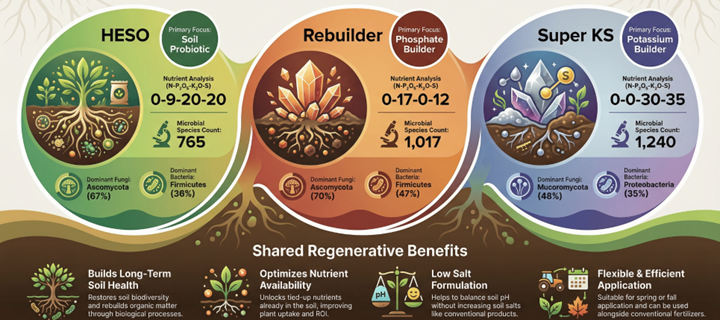
Replenish Nutrients’ product portfolio currently consists of three primary biological granules that together form a complementary soil-health platform:
SuperKS™ (0-0-30-30)
A sulfur and potassium pellet designed to unlock tied-up nutrients in soil, mobilizing phosphorus, potassium, sulfur, and iron through microbial activity and mineral weathering processes.
HESO™ (0-9-20-20)
A biologically active granule focused on nutrient cycling and organic matter breakdown. Independent analysis has identified approximately 765 microbial species within the formulation, supporting nitrogen mineralization, calcium and iron mobilization, and improved stress tolerance.
Rebuilder™ (0-17-0-12)
A high-biodiversity soil restoration product containing approximately 1,017 microbial species, designed to digest crop residue, improve soil structure, and restore nutrient cycling within degraded soils.
Together, these products function as a coordinated soil-health system. SuperKS focuses on unlocking existing nutrients, HESO accelerates nutrient cycling and microbial activity, and Rebuilder works to restore soil structure and biological function over time.
Exhibit 1: Replenish Nutrients Product Portfolio: Validated by Science, Proven in the Field
Source: Company Reports
Competitors
Replenish Nutrients operates within a specialized segment of the agricultural input market focused on regenerative fertilizers and soil health. Because the Company bridges the gap between traditional chemical fertilizers and organic biologicals products by combining mineral nutrients with biological activation, their competitors range from global giants to specialized ag-tech startups and emerging regenerative fertilizer companies.
Regenerative & Specialty Fertilizer Companies
The most direct competitors are companies developing similar natural, mineral-based, or biological-infused fertilizers that focus on soil microbiology rather than just high-nitrogen chemical spikes.
Verde AgriTech (TSX: NPK, Market Capitalization: ~$65M)
A major competitor in the sustainable potash space. Verde AgriTech produces ‘K-Forte,’ a multinutrient potassium fertilizer that, like Replenish’s products, improves soil health and provides long-term nutrient release. The primary difference is that Replenish multi-nutrient delivery system activates existing soil biology, whereas Verde focuses on a specific mineral (Glauconite) as a slow-release, low-carbon potash source.
MustGrow Biologics (TSXV: MGRO, Market Capitalization: ~$32M)
An ag-tech company providing natural biopesticides and biofertilizers derived from mustard seed. While targeting on ‘biologics,’ MustGrow Biologics competes for the same ‘green’ acre as Replenish. Replenish and MustGrow are both stars in the regenerative agriculture space but play entirely different positions on the field. The simplest way to think about it: Replenish is the ‘Main Course’ (the actual food/fertilizer), while MustGrow is the ‘Medicine and Vitamin’ (protection and growth stimulation).
These firms, among many others, compete for acreage within the growing regenerative agriculture segment, where growers are increasingly adopting biological or specialty nutrient products to complement conventional fertilizer programs.
Global Fertilizer Giants (The ‘Legacy’ Competition)
Replenish also operates alongside large global fertilizer companies that dominate the conventional nitrogen, phosphate, and potash markets. While these companies primarily sell traditional synthetic fertilizers (which Replenish aims to replace), they are increasingly investing in biological inputs and sustainability initiatives. As agriculture transitions toward lower-carbon and soil-health-oriented solutions these companies will also seek to capture a share of the regenerative market.
Nutrien (TSX: NTR, Market Capitalization: ~$55B)
The world’s largest fertilizer producer. Nutrien has a growing ‘Sustainability and Stewardship’ wing and is increasingly moving into carbon-tracking and biological products. Nutrien has actively pursued the acquisition and development of regenerative agriculture, biocontrol, and biostimulant technologies to support sustainable farming.
The Mosaic Company (NYSE:MOS, Market Capitalization: ~US$10B)
One of the largest integrated producers of concentrated phosphate and potash, two of the three most important nutrients in agriculture. Mosaic offers specialized performance products (like MicroEssentials) that compete with Replenish’s granulated blends for efficiency and yield.
Nutrien and The Mosaic Company dominate the global commodity fertilizer market, producing nitrogen, phosphate, and potash fertilizers at large scale. While they are not direct biological competitors to Replenish, they control the baseline fertilizer market that regenerative and specialty alternatives seek to replace as agricultural practices evolve.
How Replenishes Solutions Differ
Replenish’s products are designed around biological nutrient cycling rather than simply adding additional fertilizer inputs. Microbial communities within the products help release nitrogen, phosphorus, potassium, sulfur, calcium, and iron from organic matter and soil mineral reserves, improving nutrient availability throughout the growing season.
From a sustainability perspective, Replenish positions its platform as a lower-carbon alternative to conventional fertilizer production. The Company reports that its manufacturing process can deliver approximately 50% lower carbon intensity compared to conventional synthetic fertilizers, while also utilizing a closed-loop system that converts organic waste streams into finished fertilizer products.
The technology has also been supported by early field validation. Replenish products have been tested and utilized across over one million acres of agricultural land, providing real-world performance data on nutrient cycling, soil health improvements, and crop productivity.
Replenish’s technology platform is designed to address many of the limitations associated with conventional fertilizer systems by combining mineral nutrients with biological nutrient cycling. Rather than relying solely on synthetic inputs that deliver nutrients rapidly through high-salt formulations, the Company’s products are designed to activate nutrients through microbial processes within the soil ecosystem:
Mineral-Based + Microbial Activation
Replenish formulations rely on mineral nutrients that are converted into plant-available forms through microbial activity, allowing nutrients to be released in alignment with plant demand.
Low-Salt, Soil-Friendly Formulations
Unlike many conventional fertilizers, the Company’s products are designed to minimize salt accumulation that can disrupt soil microbiology and degrade soil structure over time.
Patented Production Processes
Replenish holds patents related to its granulation and pelletization technologies, which integrate mineral nutrients with biological components into stable fertilizer granules compatible with standard farm equipment.
Alignment with Organic & Regenerative Standards
Replenish’s products are designed to be compatible with organic and regenerative agriculture frameworks, including Organic Materials Review Institute (OMRI) standards.
Together, these attributes differentiate Replenish from traditional fertilizer manufacturers by combining biological nutrient activation, soil-friendly formulations, proprietary production processes, and alignment with regenerative agricultural practices.
Validation from One of the Largest Farmer Co-ops in the United States
In addition to growing industry interest, Farmers Union Enterprise (FUE), one of the largest agricultural cooperatives in the United States, has completed testing of the product and is now moving toward licensing it for use across its member network (Minnesota, Montana, North Dakota, South Dakota, and Wisconsin). The cooperative represents more than 70 million acres of farmland, demonstrating the potential scale of commercial deployment beyond the initial 50,000-tonne, 500,000-acre facility. This early validation from a large producer network highlights both the product’s practical on-farm applicability and the opportunity for significant acreage adoption. A more detailed review of FUE’s licensing framework will be discussed in Sophic Capital’s next report.
Conclusion
Replenish’s approach centers on a biologically integrated fertilizer system designed to work with soil processes. The Company’s products combine mineral nutrients with microbial communities that activate nutrient cycling in the soil, allowing nutrients to be converted into plant-available forms when crops need them most. This approach aims to improve nutrient availability, strengthen soil structure, and enhance crop resilience over time, supporting long-term soil productivity.
A key element of the Company’s strategy is biological nutrient cycling rather than simply increasing fertilizer inputs. By activating nutrients already present in soil minerals and organic matter, Replenish seeks to deliver both agronomic and environmental benefits.
Coming Up…
While the agricultural platform and product portfolio establish the foundation of the Replenish’s value proposition, the licensing model represents the primary mechanism through which Sophic Capital Client Replenish Nutrients Holding Corp. [CSE: ERTH, OTC: VVIVF] intends to scale its regenerative fertilizer platform across global agricultural markets.
In our next report, we examine the economics and strategic implications of this licensing model in greater detail, including production capacity potential and acreage coverage scenarios.
For More Research
Access more Replenish Nutrients Holding Corp. research HERE
Sign up for Sophic Capital’s reports HERE
Disclosures
Replenish Nutrients Holding Corp. [CSE: ERTH, OTC: VVIVF] has contracted Sophic Capital for capital markets advisory and investor relations services.
Disclaimers
The information and recommendations made available through our emails, newsletters, website and press releases (collectively referred to as the “Material”) by Sophic Capital Inc. (“Sophic” or “Company”) is for informational purposes only and shall not be used or construed as an offer to sell or be used as a solicitation of an offer to buy any services or securities. In accessing or consuming the Materials, you hereby acknowledge that any reliance upon any Materials shall be at your sole risk. None of the information provided in our monthly newsletter and emails or any other Material should be viewed as an invite, and/or induce or encourage any person to make any kind of investment decision. The recommendations and information provided in our Material are not tailored to the needs of particular persons and may not be appropriate for you depending on your financial position or investment goals or needs. You should apply your own judgment in making any use of the information provided in the Company’s Material, especially as the basis for any investment decisions. Securities or other investments referred to in the Materials may not be suitable for you and you should not make any kind of investment decision in relation to them without first obtaining independent investment advice from a qualified and registered investment advisor. You further agree that neither Sophic, its, directors, officers, shareholders, employees, affiliates consultants, and/or clients will be liable for any losses or liabilities that may be occasioned as a result of the information provided in any of the Material. By accessing Sophic’s website and signing up to receive the Company’s monthly newsletter or any other Material, you accept and agree to be bound by and comply with the terms and conditions set out herein. If you do not accept and agree to the terms, you should not use the Company’s website or accept the terms and conditions associated to the newsletter signup. Sophic is not registered as an adviser or dealer under the securities legislation of any jurisdiction of Canada or elsewhere and provides Material on behalf of its clients pursuant to an exemption from the registration requirements that is available in respect of generic advice. In no event will Sophic be responsible or liable to you or any other party for any damages of any kind arising out of or relating to the use of, misuse of and/or inability to use the Company’s website or Material. The information is directed only at persons resident in Canada. The Company’s Material or the information provided in the Material shall not in any form constitute as an offer or solicitation to anyone in the United States of America or any jurisdiction where such offer or solicitation is not authorized or to any person to whom it is unlawful to make such a solicitation. If you choose to access Sophic’s website and/or have signed up to receive the Company’s monthly newsletter or any other Material, you acknowledge that the information in the Material is intended for use by persons resident in Canada only. Sophic is not an investment advisor, nor does it maintain any registrations as such, and Material provided by Sophic shall not be used to make investment decisions. Information provided in the Company’s Material is often opinionated and should be considered for information purposes only. No stock exchange or securities regulatory authority anywhere has approved or disapproved of the information contained herein. There is no express or implied solicitation to buy or sell securities. Sophic and/or its principals and employees may have positions in the stocks mentioned in the Company’s Material and may trade in the stocks mentioned in the Material. Do not consider buying or selling any stock without conducting your own due diligence and/or without obtaining independent investment advice from a qualified and registered investment advisor. The Company has not independently verified any of the data from third party sources referred to in the Material, including information provided by Sophic clients that are the subject of the report, or ascertained the underlying assumptions relied upon by such sources. The Company does not assume any responsibility for the accuracy or completeness of this information or for any failure by any such other persons to disclose events which may have occurred or may affect the significance or accuracy of any such information.
The Material may contain forward looking information. Forward-looking statements are frequently, but not always, identified by words such as “expects,” “anticipates,” “believes,” “intends,” “estimates,” “potential,” “possible,” “projects,” “plans,” and similar expressions, or statements that events, conditions or results “will,” “may,” “could,” or “should” occur or be achieved or their negatives or other comparable words and include, without limitation, statements regarding, projected revenue, income or earnings or other results of operations, strategy, plans, objectives, goals and targets, plans to increase market share or with respect to anticipated performance compared to competitors, product development and adoption by potential customers. These statements relate to future events and future performance. Forward-looking statements are based on opinions and assumptions as of the date made and are subject to a variety of risks and other factors that could cause actual events/results to differ materially from these forward-looking statements. There can be no assurance that such expectations will prove to be correct; these statements are no guarantee of future performance and involve known and unknown risks, uncertainties and other factors. Sophic provides no assurance as to future results, performance, or achievements and no representations are made that actual results achieved will be as indicated in the forward-looking information. Nothing herein can be assumed or predicted, and you are strongly encouraged to learn more and seek independent advice before relying on any information presented.