
The Quantum-AI Convergence
Quantum Risk & AI Integrity
Introduction
We believe the market is poised to enter a multi-year post-quantum migration cycle. Public-key cryptography remains a deeply embedded standard across enterprise software, communications, financial systems, digital assets, and increasingly, AI workflows. Public-key cryptography is also susceptible to potential vulnerabilities as quantum computing, which can easily break this encryption becomes more common-place, rendering all current data protection and privacy standards largely obsolete. The debate is now no longer whether post-quantum migration will occur, but how quickly it must happen as quantum computing becomes a practical infrastructure, compliance, and commercial issue.
The urgency is not driven solely by the eventual arrival of a cryptographically relevant quantum computer. It is also being driven by the growing risk of harvest now, decrypt later attacks, in which sensitive encrypted data is stolen today and held for future decryption. At the same time, AI is creating a second security catalyst, as enterprises look for ways to protect confidential data, model integrity, and inference privacy. Together, these forces are expanding the need and market opportunity for the next evolution across enterprise security, digital assets, and privacy-preserving AI.
The Quantum Decade – Opportunities and Challenges
While quantum computing may ultimately unlock major breakthroughs in areas such as drug discovery and materials science, it also presents a serious threat to the cryptographic foundations of the digital economy. This report outlines the urgency behind the transition to post-quantum cryptography (“PQC”), the growing importance of AI privacy and integrity, and the multi-billion-dollar opportunity emerging as governments and enterprises prepare for a quantum-capable future.
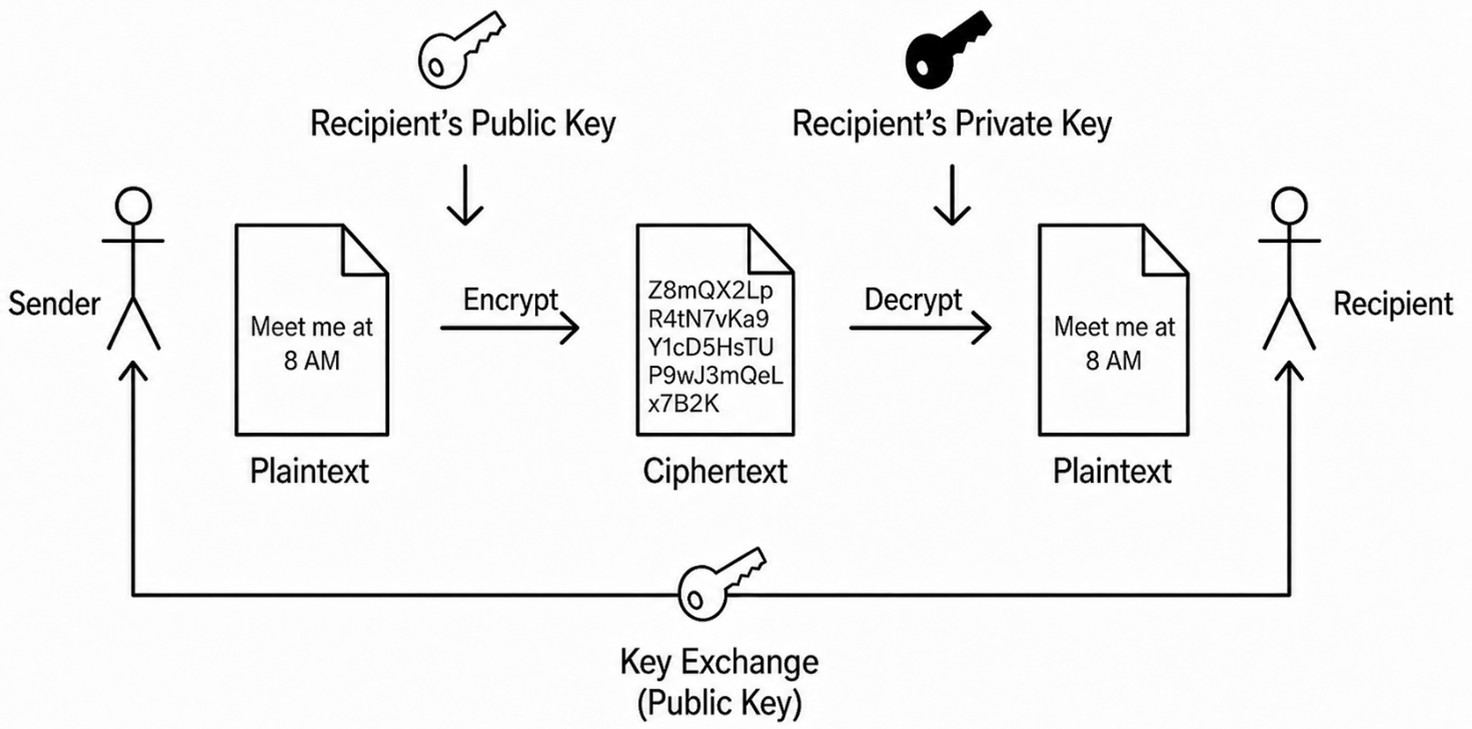
Public-key cryptography uses two different keys: a public key that others can share and use to encrypt messages, and a private key that only the owner knows and uses to decrypt them. Encryption transforms a message into unreadable data using a mathematical process, while decryption reverses that process to restore the original message. It also supports authentication and non-repudiation, because a message signed with a private key can be verified with the corresponding public key. This matters for quantum cybersecurity because many widely used public-key systems could eventually be broken by sufficiently powerful quantum computers, making the transition to post-quantum cryptography critical for protecting digital communications, identities, and transactions.
Rivest-Shamir-Adleman (“RSA”) is one specific mathematical algorithm used to perform public-key cryptography. It relies on the difficulty of factoring large prime numbers. While traditional public-key systems like RSA paved the way for secure communication, the need for faster processing and smaller keys led to the development of Elliptic Curve Cryptography (“ECC”), which offers the same level of security with significantly higher efficiency.
The core “quantum problem” for ECC is that a sufficiently powerful quantum computer can solve the Elliptic Curve Discrete Logarithm Problem (“ECDLP”) almost instantly. While ECC is currently highly secure because reversing its mathematical operations is nearly impossible for classical computers, Shor’s algorithm provides an exponential shortcut that breaks this defense. Because standard ECC and RSA are not “quantum-resistant,” the industry is migrating to PQC.
The Commercial Opportunity Extends Before “Q-Day”
The traditional narrative focuses on Q-Day: the point at which a cryptographically relevant quantum computer can break widely used encryption systems currently securing global digital infrastructure such as RSA and ECC. Various experts peg that date as somewhere between and 2029. While that milestone remains uncertain in timing, the commercial implications are already emerging, more importantly, like the Y2K challenge, potentially impacted entities need to act to mitigate possible risks a few years before the risk could materialize.
The most immediate concern is harvest now, decrypt later. The core issue is that many digital systems rely on cryptographic standards that were never designed for a quantum-capable future. Long-lived or highly sensitive data tied to identity, authentication, secure communications, financial messaging, remote access, and digital signatures may already be exposed to future compromise if it is being harvested today. In addition, to enterprise data, these challenges are also especially relevant to digital assets (e.g. cryptocurrencies), as these assets, at an implementation level, are simply data.
This is why the issue has moved beyond theory and into planning. NIST finalized its first three post-quantum cryptography standards (FIPS 203, 204, 205), giving governments and enterprises a standards-based foundation for migration along with the White House’s NSM-10 and OMB migration memorandum requiring U.S. federal agencies to inventory vulnerable cryptography. Beyond just the U.S., regulators and policymakers in Canada, the U.K., Europe, and Asia have increasingly moved from awareness to implementation planning, creating multi-year migration windows that are already underway.
Private-sector behavior reinforces this trend. Large technology companies and infrastructure providers are beginning to normalize hybrid post-quantum approaches and crypto-agility, signaling that the broader ecosystem is moving toward deployment. Apple has deployed hybrid quantum-secure cryptography in its security stack, Cloudflare said post-quantum encryption secured 52% of all human traffic on its network in 2025, and Google published new research in March 2026 arguing that future quantum computers may be able to break elliptic-curve cryptography with fewer resources than previously thought. In other words, the ecosystem is already acting to mitigate the risks.
How AI Adds Another Layer to the Privacy Equation
Quantum migration is only part of the story. AI is creating a second, more immediate demand driver.
As AI becomes more deeply embedded across enterprise workflows, organizations are facing growing concerns around data privacy, model confidentiality, and secure inference. Enterprises are increasingly using AI systems to process regulated information, proprietary models, internal knowledge, and confidential customer data. In that environment, security concerns extend beyond the risk of future quantum attacks.
This creates a broader AI integrity challenge. Organizations want to protect both sides of the interaction: the user’s input and the model’s intellectual property. Without secure inference infrastructure, enterprises may hesitate to deploy AI in their most valuable and sensitive applications. This is particularly relevant in sectors such as financial services, healthcare, defence, government, legal services, and critical infrastructure.
In our view, this is a key point for investors: the emerging security opportunity is not dependent on quantum timelines alone. Even before Q-Day, enterprises already have reasons to invest in privacy-preserving AI infrastructure.
Where the Opportunity is Emerging Centered On Data Sensitivity
The most relevant challenges span three adjacent problem sets: quantum-safe enterprise data access and communications, quantum-safe digital assets, and privacy-preserving AI. Each sit on top of the same core concern: sensitive systems built on cryptography and data flows that were not originally designed for a quantum-capable future or for confidential AI inference.
Quantum-safe Enterprise Remote Access and Communications
Identity and access systems are a logical early market because they are both mission-critical entry-points and already undergoing modernization. However, the entire path traversed by data needs to be “hardened” to keep pace with newly evolving challenges. As enterprises move from perimeter-based architectures toward zero-trust access models, there is a natural opportunity to upgrade cryptography at the same time, since it permeates this entire stack that data travels over, and resides in. Secure communications, email, authentication, and remote access therefore represent early beachheads for post-quantum adoption.
Quantum-safe Digital Assets
Digital assets are another natural early market because many blockchain networks, wallets, and related systems, all represent data, and rely on elliptic-curve signatures that could become vulnerable in a quantum-capable future. If the migration window compresses, wallets, custodians, exchanges, bridges, stablecoins, and Layer 1 or protocol foundations will need practical infrastructure upgrade paths rather than abstract cryptographic libraries.
Privacy-preserving AI
AI broadens the commercial opportunity beyond pure post-quantum migration. Enterprises already worry about prompt privacy, data leakage, model extraction, and AI operating on regulated or highly confidential information. As a result, solutions that can protect both user data and model IP while still delivering usable outputs may address a live commercial need well before full-scale quantum disruption arrives.
Where Current Solutions Fall Short
Most current market solutions fall into three buckets. First, there are standards and technical components, including NIST-approved algorithms, cryptographic libraries, hardware security modules, and key management tools. Second, there are infrastructure and platform vendors implementing hybrid or post-quantum approaches across browsers, cloud environments, network security products, and communications systems. Third, there are services firms and systems integrators helping customers inventory vulnerable systems and plan migrations.
The challenge is that post-quantum migration is rarely straightforward. Real-world applications often require code changes, customized updates based on existing software customizations, workflow redesign, compatibility testing, performance tuning, identity and wallet upgrades, infrastructure changes, and commercial deployment support. This creates a meaningful gap between theoretical readiness and operational execution.
That gap is even more pronounced in AI. The market has no shortage of AI applications and security tools, but relatively few vendors offer an end-to-end encrypted inference environment that can protect both the input and the model while still delivering practical performance. That creates room for vendors that do more than license algorithms and instead help customers deploy usable, quantum-safe or privacy-preserving products in real world environments.
Market Size – Plenty Of Growth Through 2029/2030
The broadest top-down market is cybersecurity and AI. Privacy-preserving AI is expected to become a meaningful segment of the broader AI stack as enterprises seek secure ways to deploy sensitive workloads. More broadly, AI-related security and privacy spending is likely to increase as organizations adopt domain-specific and high-value models that require stronger confidentiality protections. Research firm, Technavio forecasts the global AI market will increase by roughly US$369.1 billion during 2025-2029, while the privacy-preserving AI market is expected to grow by about US$7.9 billion during 2025-2029 at a 27.9% CAGR.
In enterprise security, the shift toward zero-trust access and secure communications supports demand for quantum-safe upgrades layered on top of existing infrastructure. This is an attractive category because it combines security urgency with already established enterprise spending patterns, and budget cycles. For remote access and zero trust, third-party market research places the global zero-trust network access market at roughly US$1.3 billion in 2025 growing to approximately US$4.2 billion by 2030, while broader zero-trust architecture spending is measured in the tens of billions.
For digital assets, the opportunity is less about one research estimate and more about installed value at risk. Major blockchain ecosystems, stablecoins and crypto wallets collectively secure hundreds of billions of dollars of assets, and the migration challenge spans exchanges, custody, wallets, bridges and Layer 1 protocols. Google’s March 2026 work on elliptic-curve cryptography has made this topic more visible to token foundations and crypto infrastructure operators.
Tailwinds, Regulation and Policy Support
One of the strongest market tailwinds is that post-quantum migration is becoming policy-led rather than purely optional. Governments are no longer treating the issue as a distant and abstract risk. NIST has published PQC standards, whereby federal agencies and their contractors (Primes) are mandated to have migration roadmaps in place. CISA, NSA and NIST jointly issued memoranda and guidance requiring inventory work and migration planning. The Government of Canada now has a roadmap that targets high-priority system migration by 2031 and remaining systems by 2035.
In Europe, digital resilience rules are raising expectations around security, continuity, and infrastructure assurance. The Digital Operational Resilience Act (DORA) has applied in the EU since January 17, 2025, and raises the standard for cyber resilience across banks, insurers, investment firms and other financial entities. Even when rules do not mandate a specific algorithm, they create urgency around resilience, vendor assurance and operational continuity. The U.K.’s National Cyber Resilience Center (NCSC) published a phased roadmap with 2028, 2031 and 2035 milestones. Japan and broader Asia are also relevant due advanced infrastructure markets, and growing interest in secure communications and digital assets.
More importantly, once governments and major institutions begin treating quantum readiness and cyber resilience as required planning exercises, vendors that can help customers execute gain a structural tailwind. Regulation does not need to mandate a specific algorithm to create commercial demand, which acts to stimulate market demand across the entire category of relevant solutions.
A second tailwind is ecosystem validation. Large technology vendors are already moving toward crypto-agility and hybrid post-quantum architectures. That should reduce buyer resistance over time and help normalize procurement decisions in this category.
A third tailwind is the growing connection between AI adoption and privacy requirements. As AI moves deeper into regulated and mission-critical environments, the need for secure, confidential inference may become a separate catalyst for adoption, even before quantum migration becomes urgent.
Industry and Market Risks
Despite the opportunity, the market still carries meaningful risks.
Timing risk remains real. Quantum timelines are uncertain, which means some buyers may delay migration until deadlines become harder or threats become more visible. That can slow near-term purchasing decisions even if the long-term direction is clear. On the other hand, a sudden and unanticipated research breakthrough or improvement in quantum computing could stimulate demand overnight, even as the various solutions and vendors may not be necessarily prepared.
Performance and implementation also matter. PQC and privacy-preserving AI approaches such as fully homomorphic encryption (“FHE”) can introduce latency, complexity, and deployment challenges. Vendors that cannot demonstrate usable real-world performance may struggle to convert pilots into revenue.
The competitive field is evolving quickly. Large infrastructure vendors, niche PQC companies, established cybersecurity firms, and global systems integrators may all pursue the same budgets. Because standards are public, long-term differentiation will likely come from execution, integration, partnerships, and commercial delivery rather than standards ownership alone.
In digital assets, regulatory uncertainty and crypto volatility can influence customer budgets and token-economics narratives. In AI, the commercialization window depends on enterprises being willing to pay for privacy-preserving inference rather than merely discussing it.
Finally, execution risk is especially relevant for emerging companies pursuing multiple verticals at once. The opportunity is broad but focus and disciplined commercialization will matter.
Conclusion
The market backdrop is increasingly supportive: Standards have arrived, governments are publishing migration roadmaps, large technology vendors are validating the transition, and AI privacy concerns are creating a second demand driver beyond pure quantum timing. The opportunity is broad, growing, global, and increasingly policy supported, even if timing, performance, and competitive risks remain meaningful. In other words, this is no longer just a future theoretical technical problem. It is becoming a present-day infrastructure, compliance, and security challenge across enterprise systems, digital assets, and AI.
Coming Up…
In Sophic Capital’s next Report, we move from market context to company context, examining how Sophic Capital Client 01 Quantum [TSXV: ONE, OTCQB: OONEF] is positioning itself to address these challenges through its IronCAP™ technology and commercialize practical solutions across remote access, digital assets and privacy-preserving AI.
Disclosures
01 Quantum Inc. [TSXV: ONE, OTCQB: OONEF] has contracted Sophic Capital for capital markets advisory and investor relations services.
Disclaimers
The information and recommendations made available through our emails, newsletters, website and press releases (collectively referred to as the “Material”) by Sophic Capital Inc. (“Sophic” or “Company”) is for informational purposes only and shall not be used or construed as an offer to sell or be used as a solicitation of an offer to buy any services or securities. In accessing or consuming the Materials, you hereby acknowledge that any reliance upon any Materials shall be at your sole risk. In particular, none of the information provided in our monthly newsletter and emails or any other Material should be viewed as an invite, and/or induce or encourage any person to make any kind of investment decision. The recommendations and information provided in our Material are not tailored to the needs of particular persons and may not be appropriate for you depending on your financial position or investment goals or needs. You should apply your own judgment in making any use of the information provided in the Company’s Material, especially as the basis for any investment decisions. Securities or other investments referred to in the Materials may not be suitable for you and you should not make any kind of investment decision in relation to them without first obtaining independent investment advice from a qualified and registered investment advisor. You further agree that neither Sophic, its, directors, officers, shareholders, employees, affiliates consultants, and/or clients will be liable for any losses or liabilities that may be occasioned as a result of the information provided in any of the Material. By accessing Sophic’s website and signing up to receive the Company’s monthly newsletter or any other Material, you accept and agree to be bound by and comply with the terms and conditions set out herein. If you do not accept and agree to the terms, you should not use the Company’s website or accept the terms and conditions associated to the newsletter signup. Sophic is not registered as an adviser or dealer under the securities legislation of any jurisdiction of Canada or elsewhere and provides Material on behalf of its clients pursuant to an exemption from the registration requirements that is available in respect of generic advice. In no event will Sophic be responsible or liable to you or any other party for any damages of any kind arising out of or relating to the use of, misuse of and/or inability to use the Company’s website or Material. The information is directed only at persons resident in Canada. The Company’s Material or the information provided in the Material shall not in any form constitute as an offer or solicitation to anyone in the United States of America or any jurisdiction where such offer or solicitation is not authorized or to any person to whom it is unlawful to make such a solicitation. If you choose to access Sophic’s website and/or have signed up to receive the Company’s monthly newsletter or any other Material, you acknowledge that the information in the Material is intended for use by persons resident in Canada only. Sophic is not an investment advisor nor does it maintain any registrations as such, and Material provided by Sophic shall not be used to make investment decisions. Information provided in the Company’s Material is often opinionated and should be considered for information purposes only. No stock exchange or securities regulatory authority anywhere has approved or disapproved of the information contained herein. There is no express or implied solicitation to buy or sell securities. Sophic and/or its principals and employees may have positions in the stocks mentioned in the Company’s Material and may trade in the stocks mentioned in the Material. Do not consider buying or selling any stock without conducting your own due diligence and/or without obtaining independent investment advice from a qualified and registered investment advisor. The Company has not independently verified any of the data from third party sources referred to in the Material, including information provided by Sophic clients that are the subject of the report, or ascertained the underlying assumptions relied upon by such sources. The Company does not assume any responsibility for the accuracy or completeness of this information or for any failure by any such other persons to disclose events which may have occurred or may affect the significance or accuracy of any such information.
The Material may contain forward looking information. Forward-looking statements are frequently, but not always, identified by words such as “expects,” “anticipates,” “believes,” “intends,” “estimates,” “potential,” “possible,” “projects,” “plans,” and similar expressions, or statements that events, conditions or results “will,” “may,” “could,” or “should” occur or be achieved or their negatives or other comparable words and include, without limitation, statements regarding, projected revenue, income or earnings or other results of operations, strategy, plans, objectives, goals and targets, plans to increase market share or with respect to anticipated performance compared to competitors, product development and adoption by potential customers. These statements relate to future events and future performance. Forward-looking statements are based on opinions and assumptions as of the date made, and are subject to a variety of risks and other factors that could cause actual events/results to differ materially from these forward looking statements. There can be no assurance that such expectations will prove to be correct; these statements are no guarantee of future performance and involve known and unknown risks, uncertainties and other factors. Sophic provides no assurance as to future results, performance, or achievements and no representations are made that actual results achieved will be as indicated in the forward looking information. Nothing herein can be assumed or predicted, and you are strongly encouraged to learn more and seek independent advice before relying on any information presented.