
01 Quantum: Productizing Post-Quantum Security
Implementation, Integration, and Customer Validation
Report #1 Recap
In Sophic Capitals The Quantum-AI Convergence report, we discussed how post-quantum cybersecurity is becoming a real and timely risk and market opportunity, driven not only by the eventual arrival of Q-Day but also by today’s harvest-now-decrypt-later threat, growing AI privacy concerns, and increasing regulatory pressure. We highlighted how enterprise access, digital assets, and privacy-preserving AI represent key emerging markets, supported by government roadmaps, industry adoption, and rising security spending.
The market needs practical migration and privacy solutions, not just quantum theory. The key question for investors is which companies can translate that market need into deployable products, customer adoption, and revenue. This report introduces Sophic Capital Client 01 Quantum [TSXV: ONE, OTCQB: OONEF] and why they matter in that setup.
01 Quantum – More Than Just a Technology Layer
01 Quantum, formerly 01 Communique, is an implementation-driven post-quantum cybersecurity company. Rather than simply licensing a cryptographic engine, the Company works with customers and partners to convert real applications and infrastructure into quantum-safe products.
That distinction is important. Many enterprises do not want to buy encryption technology, without an easy implementation / migration path; they want a remote-access platform, digital asset solution, email layer, or AI environment that has already been made secure and commercially usable, which easily plugs into their technology infrastructure. 01 Quantum’s strategy is built around that practical deployment model.
Why the Rebrand and Strategy Matter – An Established and Relevant History
Management has said the Company spent roughly eight years focused on quantum-safe security before rebranding from 01 Communique to 01 Quantum in 2025, as the market began paying broader attention to post-quantum migration, following recent advances in quantum technology. That history matters because 01 Quantum is not a newly assembled “theme” company built around investor interest in high profile quantum related stocks. It is an existing operating company that is repositioning around a technology base it believes is now commercially, and technologically relevant.
The strategy also appears more pragmatic than that of many earlier-stage peers. The Company’s pitch is not centered on selling a cryptographic engine in isolation. Instead, it is centered on helping customers and partners convert existing products and infrastructure into quantum-safe solutions that can be used in real-world settings.
A Deeper Look at 01 Quantum’s Technology Stack
01 Quantum’s product strategy is built around applying its core cryptographic technology across multiple security-sensitive use cases, including remote access, digital assets, AI, and communications.
At the center of the platform is IronCAP™, 01 Quantum’s standards-based post-quantum cryptography foundation. Rather than treating post-quantum cryptography (“PQC”) as a stand-alone product, the Company uses IronCAP as an underlying security layer that can be integrated into different applications and workflows. Customers typically do not want an encryption tool in isolation; they want an existing application, workflow, or platform made quantum-safe and commercially usable, which this architecture provides.
The commercial value in cybersecurity often does not come from the encryption engine alone. It comes from embedding that engine into products customers already use or need to upgrade. 01 Quantum’s technology strategy is therefore less about “selling cryptography” and more about wrapping or integrating post-quantum protection around vulnerable systems. That software-first architecture matters because it may lower deployment friction relative to more infrastructure-heavy approaches. In practical terms, it supports the Company’s broader strategy of helping customers and partners quantum-proof existing products instead of requiring a full technology rip-and-replace.
This wrapper-based approach runs across the Company’s key product categories: remote access, digital assets, communications, and AI. In practical terms, 01 Quantum is trying to identify cryptographically exposed workflows, layer in post-quantum protection, and commercialize the upgraded product through customers and partners.
Remote Access: Post-Quantum Protection for Identity and Connectivity
One of 01 Quantum’s most commercially tangible offerings is in remote access. The Company’s IronCAP-based post-quantum cryptography has been integrated into DoMobile Ver.5 with Hitachi Solutions Create, producing a PQC-enhanced zero-trust remote-access solution that entered commercial availability in Japan in late January 2026.
This is meaningful for several reasons. First, remote access is a practical entry point into post-quantum migration. Identity, authentication, and secure access systems are already core data security priorities for enterprises and are increasingly being modernized under broader zero-trust initiatives. Second, this is not just a proof-of-concept. The Hitachi relationship suggests that 01 Quantum has already been trusted to help convert an existing enterprise product into a commercial quantum-safe offering. Third, the model is attractive commercially. 01 Quantum participates through upfront development fees and ongoing royalties, allowing it to monetize both the migration work and downstream adoption without carrying the full end-market sales burden itself.
Digital Assets: Quantum-safe Wrappers for Blockchain Migration
In digital assets, 01 Quantum is addressing a different but equally practical problem: many blockchain ecosystems cannot simply migrate to post-quantum security overnight. Some of these concerns may have been attributed for weakness in Bitcoin and other cryptocurrencies recently, despite differing opinions on the cause of these declines. Wallets, custodians, exchanges, stablecoins, and Layer 1 networks may instead require phased transition tools that protect current infrastructure while broader protocol-level change takes place.
In partnership with qLABS, 01 Quantum launched $qONE and the Layer 1 Migration Toolkit, supported by its Quantum Crypto Wrapper (“QCW”) and Quantum DeFi Wrapper (“QDW”) technologies. The goal is to add quantum-safe protection to existing blockchain ecosystems without requiring immediate full-scale replacement. As digital asset operators begin taking quantum migration more seriously, practical upgrade paths are likely to matter more than abstract cryptographic libraries.
The logic here is important. Most digital asset systems still rely on elliptic-curve cryptography, which could become vulnerable in a quantum-capable future. If the market starts taking migration more seriously, the need is unlikely to be for a theoretical cryptographic standard alone. It will be for practical upgrade tools that can help wallets, custodians, exchanges, Layer 1 chains, and token ecosystems transition with minimal disruption.
01 Quantum’s approach appears designed for that use case. Rather than requiring entire ecosystems to rebuild from scratch, the Company is positioning its technology as a migration layer that can sit on top of existing infrastructure. This could be especially relevant if token foundations and infrastructure operators begin prioritizing quantum resilience before a full protocol-level transition is possible.
Quantum-safe AI: Secure Inference, Model Protection, and a Potential Platform Opportunity
The Company’s most strategically interesting solution may be its Quantum AI Wrapper (“QAW”). QAW is designed to let AI systems operate on data without exposing that data in readable form. According to the Company, the architecture combines Fully Homomorphic Encryption (“FHE”) with IronCAP™ PQC, allowing prompts, model parameters, and outputs to remain encrypted end-to-end, even if the underlying system is compromised.
That is an important technical and commercial proposition. In AI, security concerns exist on both sides of the workflow. On one side, enterprises want to protect sensitive user inputs, confidential data, and regulated information, which gains relevance and becomes a bigger risk as AI is used more for “inference” i.e. simply used more in workflows as opposed to “training” AI models. On the other, model owners want to protect their intellectual property, including model weights, tuning, and inference logic. A platform that can protect both sides simultaneously may solve a meaningful commercial problem in sectors such as financial services, defence, government, healthcare, and critical infrastructure.
The recent USPTO Notice of Allowance materially strengthens this part of the 01 story and investment thesis. The allowed patent application covers a secure AI professional / managed service for enterprises and government, including national defence, as well as a secure AI model marketplace system. The invention is designed to secure both models and user data by managing computation-preserving-cryptography encryption of data and models using public and private key pairs.
This matters for two reasons. First, from an R&D perspective, it suggests that the Company’s secure AI architecture has achieved an additional level of third-party validation and differentiation, when selling the solution to potential customers. Second, from a commercial perspective, it broadens the narrative beyond a point solution. Management is not just describing QAW as a secure inference wrapper; it is also framing the architecture as the basis for secure AI professional services, managed services, and potentially a model marketplace platform.
That marketplace angle is worth noting. If successful, it could imply a longer-term business model in which third-party AI models are deployed in a secure environment where both the customer’s data and the model provider’s IP remain protected. In theory, that could support platform economics rather than only one-time product sales. The Company has also demonstrated an application embodying QAW at its recent shareholders’ meeting. This is helpful because investors often struggle to distinguish between conceptual AI security claims and technology that has actually reached demonstration stage.
Email and Adjacent Wrapper Solutions
The Company has also highlighted quantum-safe email security and other wrapper-style applications. While these may not all be commercialized at the same pace, they are useful in showing how management thinks about productization.
The broader point is that 01 Quantum does not appear to be building separate businesses from scratch in each vertical. Rather, it is applying a common post-quantum and secure-computation architecture across multiple exposed workflows, which come with their own set of vulnerabilities, for bad actors to exploit.
That creates a potentially important strategic advantage: if the same technology base can be reused across remote access, digital assets, communications, and AI, then each new product may build on existing intellectual property and engineering work rather than requiring a full reset. If management remains disciplined, this could create operating leverage by extending the same core technology across multiple markets.
Why 01 Quantum is Positioned to Win
01 Quantum’s strongest advantage is business-model alignment. O1 Quantum is trying to monetize implementation, integration, and end-product deployment rather than simply offer core cryptography. That matters because customers often need practical migration support, not another toolkit to evaluate, which is the reason AI behemoths like Anthropic and OpenAI are building their own “deployment” companies, essentially services or consulting companies that help customers deploy and use AI more effectively.
In the same vein, a second advantage is existing live implementation experience. The Hitachi project is particularly important because it shows that a large third party entrusted 01 Quantum to convert an existing product into a quantum-safe version, and that the result has already reached commercial availability. That is stronger validation than a laboratory proof of concept alone.
A third advantage is cross-vertical reuse. The same underlying cryptographic technology and “wrapper” approach can be applied across remote access, digital assets, email, and AI. If managed with discipline, that can create more leverage than building entirely separate product families from scratch.
A fourth advantage is partner-led commercialization. In both the Hitachi and qLABS examples, 01 Quantum can participate in revenue economics without bearing the full cost of end-market sales and distribution. That may allow the Company to scale more efficiently than a model built entirely around direct enterprise sales.
A fifth advantage, now more clearly supported by the recent patent milestone, is the Company’s effort to establish a more defensible position in secure AI. The Notice of Allowance strengthens management’s ability to argue that its secure-AI approach is differentiated, technically credible, and potentially relevant to enterprise and government buyers.
Go-To-Market Positioning
From an investor standpoint, the most important contrast is not just technical, but commercial. Many participants in the post-quantum ecosystem are still focused on research, standards, or core cryptographic components. 01 Quantum is attempting to position itself closer to the deployment layer by helping customers and partners convert actual products and workflows into quantum-safe offerings.
Its strategy appears to be:
- embed post-quantum security into existing products,
- monetize integration and deployment work,
- retain downstream upside through royalties, revenue share, or platform economics.
In other words, its go-to-market model appears less centered on selling “the engine” and more centered on embedding that engine into usable products. This approach may be more commercially relevant in markets where customers care less about the specific algorithm and more about whether the remote access system, wallet, email layer, or AI environment actually works in production.
The Company also emphasizes software-based deployment, which in theory supports faster integration and broader geographic scalability than infrastructure-heavy alternatives. In Sophic Capitals next report, we will dive deeper into some of 01 Quantum’s direct comparables.
Revenue Model and Business Model Demonstrating Early Traction
01 Quantum’s business model is attractive conceptually because it blends near-term and longer-term economics. The Company has emphasized upfront engineering and development fees during product conversion work, paired with royalties, revenue sharing, or token-related upside if partner products scale successfully.
This structure means the Company does not need to wait for full end-market adoption before beginning to generate revenue. It can be paid to perform the migration and integration work itself, while retaining some downstream upside if the resulting product gains traction.
That model also helps explain why management believes the Company has sustainably moved beyond the pre-revenue stage. In Q1 fiscal 2026, revenue rose to $349,766 from $86,505 in the prior-year quarter, driven primarily by development fees tied to PQC-enabled applications across remote access, digital assets, and AI security. This early revenue suggests management’s go to market strategy is showing early results, and the solution set is more than “vaporware”.
Multiple Separate, Independent Customer, and Partner Validations
The strongest validation disclosed so far remains Hitachi Solutions Create in Japan, which has already launched DoMobile Ver.5 with 01 Quantum’s post-quantum enhancement. That gives the Company both a proof point and a reference customer.
The second major validation point is qLABS. While digital asset initiatives carry more execution and regulatory risk than traditional enterprise software, the relationship still demonstrates that external counterparties are willing to use 01 Quantum as a subject-matter expert in quantum-safe wallet and token infrastructure.
The recent USPTO Notice of Allowance adds another layer of validation on the AI side. It does not guarantee commercialization, but it does provide third-party support for the novelty and technical credibility of the Company’s secure-AI architecture, which should strengthen discussions with prospective customers, partners, and channel integrators.
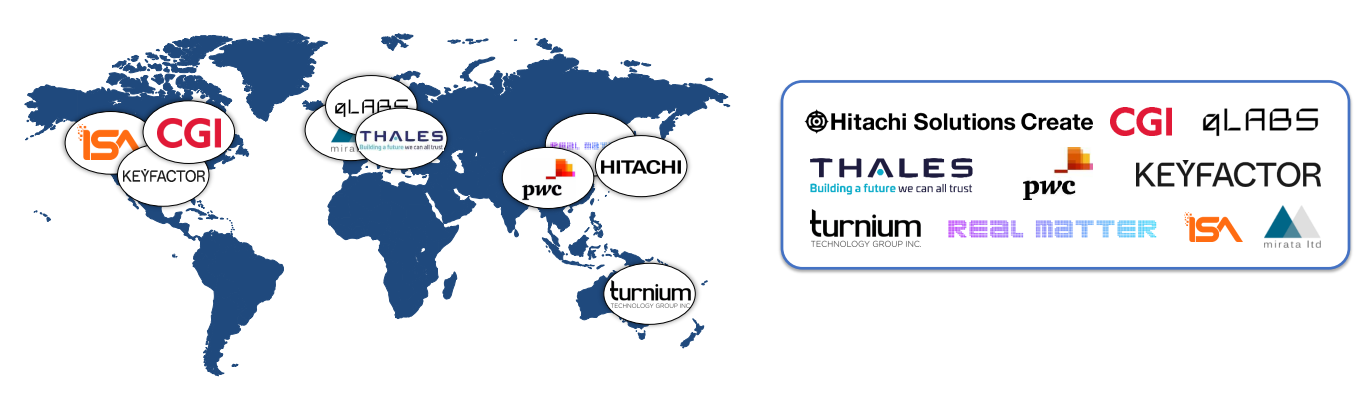
Management has also described a broader pipeline through Asia, through PwC-related channels, and through one of the world’s largest IT and business consulting firms, where 01 Quantum acts as a post-quantum subject-matter expert. These opportunities are not yet equivalent to booked revenue, but they suggest the Company may be building a channel and systems-integrator ecosystem rather than relying only on one-off direct wins.
Exhibit 1: 01 Quantum’s Global Partners
Source: Company Reports
What Investors Should Watch
The most important near-term indicators would be additional paid conversion engagements, follow-on deployments stemming from the Hitachi relationship, evidence of real adoption around digital asset protection, and the first commercially meaningful contracts in AI.
On the AI side specifically, investors should watch whether the Company can turn technical differentiation and patent support into actual enterprise or government contracts. The technology narrative is becoming stronger, but the next step is monetization.
The biggest strategic question is focus. Product breadth can be a strength if multiple offerings are built on the same core technology and sold through partners. It becomes a weakness if too many launches compete for the same cash, engineering resources, and management attention.
At this stage, the Company appears most credible when it leads with remote access as proof of commercialization, digital assets as a differentiated growth option, and AI as the longer-duration upside opportunity.
Conclusion
01 Quantum is not yet a scaled cybersecurity company, but it does appear to have a more tangible commercialization path than many public-market quantum peers as evidenced by some early revenue success. It has live products, partner-led deployments, a fee-plus-royalty business model, and an increasingly differentiated narrative around privacy-preserving AI.
The recent patent milestone adds depth to the secure-AI story by supporting management’s claim that QAW is not just a concept, but the foundation for a broader secure AI services and marketplace platform. The central investment question now is whether the Company can continue turning technical capability and early validation into repeatable commercial outcomes.
Coming Up…
In Sophic Capital’s next report, we examine 01 Quantum’s valuation relative to peers such as QNC and BTQ, its broader pipeline, and the potential scale of the opportunity if management continues to execute across remote access, digital assets, and AI privacy.
Disclosures
01 Quantum Inc. [TSXV: ONE, OTCQB: OONEF] has contracted Sophic Capital for capital markets advisory and investor relations services.
Disclaimers
The information and recommendations made available through our emails, newsletters, website and press releases (collectively referred to as the “Material”) by Sophic Capital Inc. (“Sophic” or “Company”) is for informational purposes only and shall not be used or construed as an offer to sell or be used as a solicitation of an offer to buy any services or securities. In accessing or consuming the Materials, you hereby acknowledge that any reliance upon any Materials shall be at your sole risk. In particular, none of the information provided in our monthly newsletter and emails or any other Material should be viewed as an invite, and/or induce or encourage any person to make any kind of investment decision. The recommendations and information provided in our Material are not tailored to the needs of particular persons and may not be appropriate for you depending on your financial position or investment goals or needs. You should apply your own judgment in making any use of the information provided in the Company’s Material, especially as the basis for any investment decisions. Securities or other investments referred to in the Materials may not be suitable for you and you should not make any kind of investment decision in relation to them without first obtaining independent investment advice from a qualified and registered investment advisor. You further agree that neither Sophic, its, directors, officers, shareholders, employees, affiliates consultants, and/or clients will be liable for any losses or liabilities that may be occasioned as a result of the information provided in any of the Material. By accessing Sophic’s website and signing up to receive the Company’s monthly newsletter or any other Material, you accept and agree to be bound by and comply with the terms and conditions set out herein. If you do not accept and agree to the terms, you should not use the Company’s website or accept the terms and conditions associated to the newsletter signup. Sophic is not registered as an adviser or dealer under the securities legislation of any jurisdiction of Canada or elsewhere and provides Material on behalf of its clients pursuant to an exemption from the registration requirements that is available in respect of generic advice. In no event will Sophic be responsible or liable to you or any other party for any damages of any kind arising out of or relating to the use of, misuse of and/or inability to use the Company’s website or Material. The information is directed only at persons resident in Canada. The Company’s Material or the information provided in the Material shall not in any form constitute as an offer or solicitation to anyone in the United States of America or any jurisdiction where such offer or solicitation is not authorized or to any person to whom it is unlawful to make such a solicitation. If you choose to access Sophic’s website and/or have signed up to receive the Company’s monthly newsletter or any other Material, you acknowledge that the information in the Material is intended for use by persons resident in Canada only. Sophic is not an investment advisor nor does it maintain any registrations as such, and Material provided by Sophic shall not be used to make investment decisions. Information provided in the Company’s Material is often opinionated and should be considered for information purposes only. No stock exchange or securities regulatory authority anywhere has approved or disapproved of the information contained herein. There is no express or implied solicitation to buy or sell securities. Sophic and/or its principals and employees may have positions in the stocks mentioned in the Company’s Material and may trade in the stocks mentioned in the Material. Do not consider buying or selling any stock without conducting your own due diligence and/or without obtaining independent investment advice from a qualified and registered investment advisor. The Company has not independently verified any of the data from third party sources referred to in the Material, including information provided by Sophic clients that are the subject of the report, or ascertained the underlying assumptions relied upon by such sources. The Company does not assume any responsibility for the accuracy or completeness of this information or for any failure by any such other persons to disclose events which may have occurred or may affect the significance or accuracy of any such information.
The Material may contain forward looking information. Forward-looking statements are frequently, but not always, identified by words such as “expects,” “anticipates,” “believes,” “intends,” “estimates,” “potential,” “possible,” “projects,” “plans,” and similar expressions, or statements that events, conditions or results “will,” “may,” “could,” or “should” occur or be achieved or their negatives or other comparable words and include, without limitation, statements regarding, projected revenue, income or earnings or other results of operations, strategy, plans, objectives, goals and targets, plans to increase market share or with respect to anticipated performance compared to competitors, product development and adoption by potential customers. These statements relate to future events and future performance. Forward-looking statements are based on opinions and assumptions as of the date made, and are subject to a variety of risks and other factors that could cause actual events/results to differ materially from these forward looking statements. There can be no assurance that such expectations will prove to be correct; these statements are no guarantee of future performance and involve known and unknown risks, uncertainties and other factors. Sophic provides no assurance as to future results, performance, or achievements and no representations are made that actual results achieved will be as indicated in the forward looking information. Nothing herein can be assumed or predicted, and you are strongly encouraged to learn more and seek independent advice before relying on any information presented.